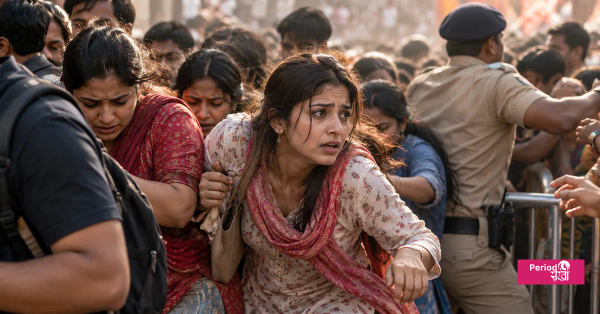

“Stampede broke out after a misleading announcement was made by the organisers of the Durga Puja pandal,” says Chief Minister Suvendu Adhikari
Let's assume, Priya has been waiting all year to visit a famous Durga Puja pandal in Kolkata. She goes with her mother and a friend, hoping to enjoy the lights, decorations and festive atmosphere. When they reach the entrance, the crowd is much larger than they expected. People begin pushing from behind.
For Priya, the visit that began with excitement has become frightening.
Crowded religious gatherings, festivals, concerts, rallies and public celebrations can become dangerous when too many people enter a limited space. A stampede can cause crushing injuries, breathing difficulties, falls and even death.
PeriodSakhi began with a focus on periods and menstrual health. But women’s health is much bigger than menstruation. It also includes physical safety, mental well-being, emergency care and the everyday situations that can put a woman’s health at risk.
Women who are pregnant, menstruating, caring for children or living with a medical condition may need particular support in crowded places. Others may struggle to reach toilets, find help or protect their personal space in a tightly packed crowd. Let's understand more about stampedes.
Stampede: Stampede is the disruption of the orderly movement of crowds which leads to injuries and fatalities. This impulsive mass movement of crowd often takes place in response to a perceived danger, loss of physical space or a will to attain something as gratifying.
Process of a Stampede

If you’ve ever been to a big concert, rally, sports event, or festival, you may have found yourself in the midst of a crowd of people packed together as far as the eye can see. Such large gatherings are common and usually don't result in any serious problems.
But if a crowd surges beyond the capacity of the space, or if there’s bad crowd management, chaos could result. When a crowd of people moves in the same direction at the same time, some may collide and pile up against or on top of each other. This can get very dangerous very quickly. Experts refer to such an incident as a stampede, crowd surge, or crowd crush.
Human stampedes have occurred at various types of gatherings around the world. Between 1980 and 2022, there were an estimated 440 crowd surge incidents, which led to more than 13,700 deaths and 27,000 injuries.
As the crowd begins to move, usually in the same direction, people jammed against one another start to push and pull within the swaying crowd formation. Those at the back tend to push forward, since they can’t see much of what’s in front of them. For the crowd to move ahead in the same direction, the people in the front would need to match the speed of this push from behind.
But if there’s a mismatch in speed caused by panic or by something blocking the way, this can trigger a sort of domino effect. The people at the back push forward faster than those in the front can keep up.
People may fall, or they may lose consciousness due to lack of oxygen. But often, the force of such a stampede can asphyxiate you while you’re still standing. Researchers say the force of even a small crowd crush is strong enough to bend steel railings.
Trauma and Loss: Witnessing a stampede tragedy and the resultant deaths and injuries causes immense trauma, especially for those who lost loved ones. For e.g. Deadly stampede killing 121 people in Hathras.
Economic Hardship: The majority of victims in such stampedes come from lower castes and poor backgrounds. Their deaths leave families without primary breadwinners, causing economic hardship in the community. Also the cost of funerals and medical expensesfurther strain already limited resources.
Erosion of Trust: Repeated stampedes at Indian religious festivals due to similar failures further undermine faith in the ability of organizers to keep devotees safe. For e.g. Gross negligence like poor planning, with insufficient exits, inadequate crowd control, and lack of emergency preparedness, by organizers and authorities erodes trust in religious institutions.
Loss of Social and Human Capital: Many young children and women are the victims of these stampede tragedies. This leads to loss of the productive social and human capital of the country.
Every year, Kolkata welcomes large crowds during Durga Puja. Families travel across the city to visit popular pandals, admire the decorations and enjoy the celebrations. Organisers and authorities use measures such as barricades, designated routes, security personnel and crowd-control systems to help manage visitors.
However, large gatherings can still carry risks when crowd movement becomes difficult or emergency exits are obstructed.
Reports of crowd-related incidents at religious gatherings and festival venues across India have repeatedly highlighted the importance of safe entry and exit routes, effective communication, medical assistance and crowd-density monitoring.
The lesson is not that women should stop attending Durga Puja or avoid public celebrations altogether. Rather, visitors should pay attention to official safety instructions, avoid dangerously packed entrances and leave an area if movement becomes unsafe.
When visiting a popular pandal, do not assume that a queue is safe simply because it is moving slowly. If people are pressing tightly against you, you cannot move your arms freely or the crowd is surging in waves, consider these serious warning signs.
A beautiful celebration should never require you to ignore your safety.
A little preparation can make a real difference when attending a busy festival, religious gathering or public event.
Look for official updates about entry restrictions, traffic diversions, parking and visiting hours. If authorities advise people to avoid a venue, postpone your visit. Choose a less crowded time whenever possible.
Know how you will reach the venue and return home. Identify emergency exits, medical help points and meeting places in case your group gets separated. Do not rely only on your phone, as the network may become congested.
Keep your phone charged, carry identification, essential medicines and drinking water where permitted. Wear comfortable footwear that will not easily slip off. Avoid long scarves, loose clothing or bags that may get caught in barriers or other people.
If you are visiting with friends or family, agree on a meeting point outside the busiest area. Keep children and anyone needing assistance close to you, but avoid holding hands so tightly that someone could be pulled off balance.
If you are pregnant, recovering from an illness, feeling dizzy or experiencing severe menstrual cramps, consider whether a crowded venue is suitable for you. If you have a medical condition that could worsen in heat or dense crowds, discuss precautions with your healthcare professional.
There is no rule that menstruating women must avoid public gatherings. A period alone is not a reason to stay home. However, heavy bleeding, severe pain, anaemia-related weakness or dehydration can make a long, crowded outing harder to manage.
Crowd safety does not begin at the pandal entrance. It begins on the road.
During major festivals, roads may be diverted, pedestrian routes may change and vehicles may compete for limited space. Following traffic rules helps protect visitors and keeps emergency routes accessible.
Follow traffic police instructions. Use designated pedestrian crossings and footpaths, and obey temporary no-entry signs and barricades.
Avoid walking on busy roads. Never walk on a carriageway simply because the pavement is crowded.
Stay away from moving vehicles. Avoid standing in front of vehicles or gathering at road junctions to take photographs.
Keep emergency routes clear. Do not block access for ambulances, fire services or other emergency vehicles.
Follow pedestrian diversions. If police or event staff redirect pedestrians, follow their instructions instead of trying to take a shorter route.
These basic rules protect not only you but also other pedestrians, emergency responders and people trying to leave the area.
If you’re stuck in a stampede or a crowd crush, you should:
Fold your arms toward your body like a boxer to keep yourself steady and safe from being pulled or caught.
Try to keep some breathing space around your face. That’s because a lack of oxygen could cause you to faint or feel dizzy.
Keep your feet firmly on the ground.
Keep moving in the direction of the crowd. Don’t fight it or try to shove ahead.
Try to walk at the same speed as the rest of the crowd.
If you lose balance or fall to the ground, get back up on your feet as soon as possible or ask for help.If you’re not able to stand back up, curl your body into a ball and protect your head and neck area.
Steer clear from walls, railings, fences, or other solid or barricading objects. This is where crowd pressure tends to surge.
Stay calm. Try not to push or pull away from the moving crowd.
If you’re able to, edge yourself to the side of the crowd or a place where the crowd is less dense.
If there’s a fire or smoke, crouch down low. That’s because smoke rises up and could cut off your oxygen supply in tight crowds and make it harder to breathe.
If you get injured, find medical help as soon as possible. Alert medical personnel at the event venues, call 911, or head to the nearest hospital.
Protect your chest. Keep your arms bent in front of your chest, as if adopting a boxer’s stance. This can help preserve some space for breathing.
Stay on your feet. Take small steps and move with the crowd rather than trying to push directly against it.
Move towards an open area when possible. Look for a less crowded edge or a safe exit, but avoid forcing your way sideways through people.
Avoid bottlenecks. Stay away from walls, fixed barriers, closed gates and narrow doorways where people may become trapped.
Do not stop to collect belongings. Your safety is more important than a dropped phone, handbag or pair of shoes.
If you fall and cannot get up, curl onto your side and protect your head and neck with your arms. Try to make yourself as compact as possible until you can safely get up or receive help.
These steps cannot guarantee safety in a severe crowd crush, which is why avoiding dangerously dense areas early is so important.
A crowd emergency can cause more than visible injuries. Someone may experience panic, breathing difficulties, dehydration, fainting, fractures or injuries to the head and chest.
If you or someone nearby is injured, seek help from event medical staff or emergency services. Do not assume that a person who has fainted will recover without assessment. A person who has been crushed in a crowd may have serious internal injuries even when there are no obvious marks.
Difficulty breathing, chest pain, confusion, severe pain or loss of consciousness requires urgent medical attention.
If someone is unconscious and is not breathing normally, call emergency services and begin cardiopulmonary resuscitation (CPR) if you are able, following the emergency operator’s instructions. Do not move someone with a suspected serious spinal injury unless there is immediate danger or movement is necessary to provide life-saving care.
Women may also face difficulties accessing toilets, menstrual products or private spaces during an emergency.
If you are menstruating, carry a spare pad or tampon if you use one, along with tissues and a small disposal bag. If you need to change a menstrual product, do so in a safe, accessible toilet rather than entering a dangerously crowded area to reach one.
For women who are pregnant, severe abdominal pain, vaginal bleeding, fainting or breathing difficulty requires prompt medical assessment. Do not dismiss these symptoms as ordinary effects of a crowded outing.
If you’re planning to attend a concert, religious gathering, or sports event where you expect to see large, excited crowds in tight spaces, planning ahead can help you stay safe. Here are some things you can do to protect yourself:
Check the weather forecast before you leave for the venue. If it starts to rain or snow, the crowd could surge as people quickly seek shelter.
Figure out parking ahead of time so you don't have to rush to get in or out.
Don't go alone. Take a friend so you can look out for one another.
If it’s a ticketed event, give someone a copy of your seating details in case they need to find you after an emergency.
Carry your ID and cell phone with you.
Wear bright, recognizable clothes so your loved ones can find you if there's an emergency.
Don't wear long, flowy clothes or jewelry that can get caught or tangled and cause injuries.
Wear comfortable shoes and make sure your laces are tied so you don't trip.
Take a water bottle and drink plenty of fluids. You don't want to get dehydrated or dizzy when you're in the middle of an energetic crowd.
If you’re planning to take children, supervise them closely to make sure they always have enough space.
Crowd incidents at festivals and religious gatherings remind us how quickly a celebration can turn into an emergency.
In October 2026, reports concerning a fatal crowd incident at a north Kolkata Durga Puja pandal highlighted the importance of evacuation planning, safe entry and exit management, and coordination among security personnel and organisers. Such incidents need careful investigation, and casualty figures or the causes of an incident should be confirmed through reliable official updates.
The wider lesson remains important. Organisers must plan safe entry and exit routes, prevent overcrowding, communicate clearly and ensure that emergency services can reach people quickly. Police and local authorities must also help manage traffic and pedestrian movement.
Visitors have a role, too. Following instructions, avoiding blocked routes, recognising danger early and leaving when conditions become unsafe can help reduce risk.
The World Health Organization also emphasises advance risk assessment, medical preparedness, emergency response and coordination when planning large gatherings.
At PeriodSakhi, our work may begin with periods, but our commitment extends to every part of a woman’s well-being. Menstrual health, physical safety, emotional health and access to emergency care are all connected to the larger picture of women’s health.
Priya’s story could happen to anyone. A festival that brings joy can become frightening when crowd movement is unsafe. Knowing when to leave, how to protect yourself and where to seek help are practical skills that every woman deserves to have.
You do not have to choose between enjoying life and protecting your health. Celebrate, explore and take part in the occasions that matter to you, but never ignore a warning sign to please others or follow a crowd.
Your safety matters at every stage of life, every day of the month and in every place you visit.
National Disaster Management Authority (NDMA), India. Guidelines and public information on crowd management and safety.
World Health Organization. Managing health risks during mass gatherings.
The Indian Express. Reporting on the October 2026 Kolkata Durga Puja pandal crowd incident.
The Times of India. Reporting on crowd management and evacuation following the Kolkata incident.
TIME. Understanding crowd crushes and how to stay safer.
About PeriodSakhi
PeriodSakhi is your trusted companion for understanding your menstrual health. With easy-to-use tools, it helps you track your periods, ovulation, fertility, moods, and symptoms, while providing insights into your overall reproductive and hormonal health. PeriodSakhi also serves as a supportive online community where women can share experiences, find reliable information, and access expert-backed guidance on menstrual health, PCOS, pregnancy, lifestyle, and more.
Disclaimer
The views, thoughts, and opinions expressed in this article/blog are solely those of the author and do not necessarily reflect the views of PeriodSakhi. Any omissions, errors, or inaccuracies are the responsibility of the author. PeriodSakhi assumes no liability or responsibility for any content presented. Always consult a qualified medical professional for specific advice related to menstrual health, fertility, pregnancy, or related conditions.