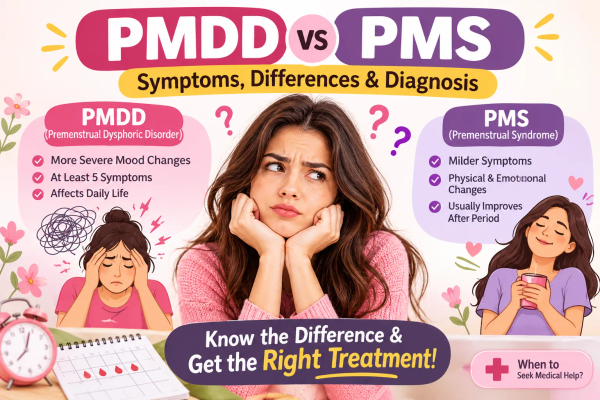

The comparison between PMDD and PMS is not straightforward since one is mild while the other is severe. PMS refers to a set of physical and psychological symptoms occurring during the premenstrual period, and their effects may range from insignificant to highly significant. PMDD is a rarer problem with specific symptoms that must be diagnosed. The symptoms include at least five symptoms, one of which must be a core mood symptom, for example, irritability, depressed mood, or anxious mood. Healthcare provider must consider the entire set of symptoms recurring in the premenstrual period.
The guide provided below contains information about the comparison of these two disorders, symptoms of the disorders, the diagnosis of PMDD, and treatment of PMDD.
Premenstrual dysphoric disorder is a mood disorder that follows the menstrual cycle. Its symptoms show up in the luteal phase, which is the stretch between ovulation and the start of a period. The DSM-5, the manual psychiatrists use for diagnosis, lists it as a condition in its own right, and the American College of Obstetricians and Gynecologists (ACOG) also treats it as a more severe and less common premenstrual disorder than PMS.
How common is it? That depends on who you ask. ACOG's guideline puts PMDD at roughly 2% to 5% of people who menstruate, while other reviews report anything from about 1% to 8%, because the criteria and the groups studied differ.
It is not just a bad temper that is difficult to manage. PMDD affects the way a person deals with his/her daily routines for a few days each month.
Since irritability and rejection sensitivity are increasing, the number of arguments that occur with one’s family members, friends, and even co-workers also grows. Any activity, from studies or office work to any activity that is normally pleasant, becomes impossible to perform without concentration and motivation. Usually, people feel overwhelmed and out of control until the beginning of their menstrual cycle. These experiences are part of the broader pattern of mood changes across the menstrual cycle, which can affect both emotional well-being and everyday functioning.
Due to the regular recurrence each month, people spend years blaming themselves for their personality traits while they actually suffer from a curable disorder.
PMS refers to the physical, psychological and behavioral changes that occur during the days before a menstrual period and cease shortly after menstruation starts. It is a common condition. According to ACOG, approximately 20% to 30% of menstruating women experience the symptoms of PMS, while a lot more observe the presence of a few of its mild symptoms from time to time.
The majority of PMS symptoms can be subdivided into three categories.
They include such physical symptoms as breast tenderness, abdominal bloating, headaches, muscle/joint pain, and temporary fluid retention-related weight gain; emotional symptoms such as irritability, mood changes, and feeling depressed; and such behavioral changes as food cravings, sleep disturbances, low energy, and difficulties concentrating.
PMS can have different impacts on one’s life and well-being. For some people, it is just an occasional nuisance, and rest, moderate exercise, a balanced diet, and stress reduction techniques can help. However, for others PMS may affect their work and home life, and consultation wit a doctor is advised regardless of whether the criteria for PMDD are met.
Because the symptoms overlap so much, no single symptom separates the two. What differs is the mix, the timing and how much life is affected. The table below sets them side by side.
Feature | PMS | PMDD |
How common | Common; roughly 20% to 30% meet PMS criteria, according to ACOG | Less common; about 2% to 5% according to ACOG, with other estimates varying |
Symptom pattern | A mix of physical and emotional symptoms before a period | At least five symptoms in the final premenstrual week, including at least one core mood symptom |
Severity | Ranges from mild to significant | Marked distress or impairment is required for diagnosis |
Emotional effects | Mood swings, irritability, feeling low or teary | Mood symptoms are prominent: intense irritability or anger, depressed mood, anxiety, marked mood swings |
Physical effects | Bloating, breast tenderness, headaches | Similar physical symptoms, alongside the mood symptoms |
Daily functioning | May be affected in some people | Work, study or relationships are noticeably affected |
Timing | Days before the period; eases once bleeding begins | Final week before the period; improves within a few days of bleeding and is minimal or absent in the week after |
Diagnosis | Based on symptom history | Specific criteria, confirmed with daily symptom ratings over at least two cycles |
Usual approach | Self-care and lifestyle changes, with medical help when needed | Often medical treatment, therapy and lifestyle support combined |
First of all, there is nothing like severe PMS that will necessarily result in PMDD. The diagnosis is based on the number of symptoms, their types, timing, the degree of suffering from those symptoms, confirmation of those symptoms via daily charting, and ruling out the possibility of some other cause for those symptoms. When it comes to distinguishing the two disorders, it should be noted that PMDD is more of meeting certain criteria than crossing some kind of threshold of severity.
What Are the Symptoms of PMDD?
The three categories of symptoms related to premenstrual dysphoric disorder have been identified by doctors, and they seek a combination of these with at least one obvious mood symptom.
Sadness that arrives suddenly, sometimes with tears or a sense of worthlessness
Irritability or anger that feels out of proportion to what set it off
Anxiety, tension or a constant feeling of being on edge
Extra sensitivity to criticism or rejection
Mood that swings quickly from one state to another
Losing interest in things you usually enjoy
Struggling to concentrate or to make even small decisions
Withdrawing from people, or having more conflicts with them
Sleeping far too much or far too little
Eating more than usual, or craving particular foods intensely
Swollen or tender breasts
Headaches
Aching joints and muscles
Bloating and a feeling of weight gain
Deep tiredness and low energy
Tiredness is easy to blame on a busy life. When it arrives alongside other severe premenstrual symptoms, though, it is worth noting where it falls in your cycle. If tiredness becomes more noticeable in the days leading up to menstruation, understanding fatigue before your period can help put this symptom into context.
Timing is a powerful factor. Normally, ovulation occurs on day 14 of the 28-day cycle and PMDD starts appearing in the week prior to the menstruation period but in some cases it can appear right after ovulation. It will worsen throughout the week, reach its peak in the last few days before bleeding and decrease during the first few days of the period.
This is the order of the things throughout the cycle.
During the follicular phase, after the period, there are no symptoms or only minimal symptoms present. They will increase during the late luteal phase, which is the week before the period, to the point where the symptoms are difficult to deal with and then they start subsiding in the first days of the bleeding.
Both syndromes have their onset in the luteal phase of the cycle, so timing will help you identify PMS and PMDD not by definitions, but in practice. The distinguishing feature of PMDD is the presence of the gap, when the symptoms disappear or become minimal and then appear again in the premenstrual week, cycle after cycle. If symptoms occur all throughout the month – it might be another disorder.
However, the exact cause is unknown. There were speculations that people who have PMDD had abnormal hormone levels. This speculation did not get much support because, according to ACOG, estrogen and progesterone cycle in the same manner with or without the presence of premenstrual disorders. The current approach assumes that there are differences in how some people react to the normal fluctuations of estrogen and progesterone.
There are several causes under consideration.
First of all, hormone sensitivity is considered. Estrogen and progesterone increase and decrease during the luteal phase, and certain people react to the changes in such a way that their moods fluctuate significantly. Serotonin, which is responsible for mood regulation, sleep and appetite, is studied in relation to its interaction with ovarian hormones. There is a hypothesis about changes in serotonin function during the late luteal phase among people with PMDD.
Understanding how serotonin influences emotional well-being can also help explain serotonin and menstrual mood changes throughout the menstrual cycle.
Researchers are also looking at allopregnanolone, a by-product of progesterone that acts on calming GABA pathways, since differences in how the brain responds to it may play a part. Dopamine and related messengers shift across the cycle too and may contribute to PMDD and severe mood changes, but research on this is limited.
Some things seem to raise the odds: a family history of PMS or PMDD, a personal or family history of depression or postpartum depression, early-life trauma, high stress and smoking. None of them guarantees PMDD, though, and plenty of people with PMDD have no such history.
No blood test or scan can confirm PMDD. Instead, doctors rely on a careful history and structured symptom records.
The DSM-5 lists several criteria, and all of them have to be met:
Five or more symptoms appear in the final week before the period, in most cycles.
At least one is a core mood symptom: marked mood swings, irritability or anger, depressed mood, or anxiety and tension.
Symptoms begin to improve within a few days of the period starting, and are minimal or absent in the week afterwards.
They cause significant distress, or they interfere with work, study, relationships or usual activities.
They aren't simply a worsening of another condition such as depression or an anxiety disorder.
Daily ratings across at least two symptomatic cycles confirm the pattern.
The problem with memory is that it distorts and exaggerates the bad days; this is why daily evaluations over at least two cycles have become the usual procedure for confirming the diagnosis, although the initial impression can be made earlier by a clinician. A diary helps in making the evaluation, although diagnosing PMDD based on the diary is not possible. The only thing that a diary can do is help detect a pattern, and that is usually the biggest hint about whether PMS may develop into PMDD.
What else the doctor may do
Apart from the aforementioned factors, a physician typically discusses your history of medical and psychological disorders, including that of your family members. The physical exam and the blood test, when required, may be performed to check whether you have thyroid disease or any other issues.
There are a number of conditions that resemble each other for this reason a detailed evaluation is required.
Depression and Anxiety Disorders: Symptoms occur throughout the whole month, while the symptoms of PMDD usually subside during the week following menstruation.
Premenstrual Exacerbation: Depression, bipolar disorder, panic disorder, or ADHD may be worsened prior to menstruation without PMDD occurring. This term is often used by clinicians to describe this type of exacerbation.
Thyroid Disorders: Either low functioning or hyperactivity of thyroid gland affects a woman's mood, weight, and energy levels.
Perimenopause: Mood changes are a consequence of hormone shifts that take place before menopause.
The main distinguishing feature of premenstrual exacerbation from PMDD is the baseline. While in the former there are no symptoms outside the premenstrual phase, in the latter a chronic condition is present all month and is only exacerbated before menstruation. Both conditions may coexist at the same time.
The mode of treatment will be personalized based on the individual. Depending on the intensity of the symptoms, personal preferences, and capability of conceiving, the type of treatment that will be suitable will be determined by the healthcare professional.
Medical treatment
SSRIs are the recommended drug treatment as per the guideline by ACOG. In contrast to the use of SSRIs for depression, their onset of action is fast; hence, they may be taken daily or during the luteal phase. According to a 2024 Cochrane review of 34 randomised trials, SSRIs might help in reducing premenstrual symptoms, and continuous administration would probably be more effective than administration in the luteal phase alone. Overall symptom pooling in this review included data from 12 randomised controlled trials involving 1,742 participants. Nausea and fatigue were among the side effects experienced, and most trials were industry-sponsored.
Hormonal options exist as well. Certain combined contraceptive pills, including some that contain drospirenone, may help some people, and a clinician needs to decide whether they're suitable. When other options haven't worked, specialists may consider treatments that suppress ovulation.
Cognitive behavioural therapy (CBT) has been found helpful for PMDD. It teaches practical ways to deal with anger, low mood and negative thinking on the harder days.
The rationale for these recommendations is less convincing, so they should be considered complementary, but not a replacement for professional health care services.
Beneficial practices are regular physical activity (e.g., walking, swimming, yoga), a stable schedule of sleep and meals, and reducing caffeine, alcohol, and sodium intake during the few days leading up to menstruation. Another strategy is taking calcium (1,000–1,200 mg daily), which the ACOG conditionally recommends (low quality evidence), as well as breathing or meditation exercises to relieve stress.
Consult a healthcare provider before taking any supplements and medications.
Yes, The PMDD symptoms diary helps make the subjective data tangible, which can then be used by your doctor. Lots of people find themselves in doubt about the severity of their symptoms, and keeping the diary gives you a clear answer. If you wish to have a continuous track on your menstrual cycle, then a period tracker for women might be helpful.
The first day of your period and the day bleeding stops
Your mood each day, scored from 1 to 5
Irritability, anxiety, sadness, and any thoughts that feel out of character
How well you slept, how hungry you were and how much energy you had
Physical symptoms such as headaches, bloating or breast pain
How much the day interfered with work, study or relationships
Do it for two full cycles and then present the results at your next visit. You may use a paper-based diary, a note-taking application or a period tracker – anything will do as long as you write something every day, rather than trying to recollect things afterwards. One such entry may look like "day 24, mood 2 out of 5, quarrelled with my sister, had bad sleep". Keeping records will enable you to describe your experiences and allow a clinician to see a pattern, however, it won't be able to provide a diagnosis by itself. It should be noted that PMDD symptoms have a specific pattern.
Book an appointment if your symptoms come back during each menstrual cycle and affect your daily life or affect your social or personal life even when you’re not certain about PMDD.
Come sooner if the mood changes are hindering your work or studies or affecting your social life or relationships, or if you’ve been having the symptoms for many months and there’s no improvement.
Feeling panicked or being extremely angry or feeling like you can’t control yourself and having symptoms throughout the month are other valid reasons to come for an appointment.
Thoughts of self-harm or suicide are a medical emergency, and they should never be dismissed as just hormones. If you are having such thoughts, contact your local emergency number or a crisis helpline right away, and reach out to a trusted person so that you are not alone.
American College of Obstetricians and Gynecologists. Management of Premenstrual Disorders: ACOG Clinical Practice Guideline No. 7. Obstetrics & Gynecology, 2023;142(6).
Jespersen C, Lauritsen MP, Frokjaer VG, Schroll JB. Selective serotonin reuptake inhibitors for premenstrual syndrome and premenstrual dysphoric disorder. Cochrane Database of Systematic Reviews, 2024;8(8):CD001396. https://doi.org/10.1002/14651858.CD001396.pub4
Carlini SV, Deligiannidis KM. Evidence-Based Treatment of Premenstrual Dysphoric Disorder: A Concise Review. Journal of Clinical Psychiatry, 2020;81(2):19ac13071. https://doi.org/10.4088/JCP.19ac13071
University Hospitals Health Library. Premenstrual Dysphoric Disorder (PMDD). https://www.uhhospitals.org/services/clinical-nutrition-services/health-library/article/diseases-and-conditions/premenstrual-dysphoric-disorder-pmd
About PeriodSakhi
PeriodSakhi is your trusted companion for understanding your menstrual health. With easy-to-use tools, it helps you track your periods, ovulation, fertility, moods, and symptoms, while providing insights into your overall reproductive and hormonal health. PeriodSakhi also serves as a supportive online community where women can share experiences, find reliable information, and access expert-backed guidance on menstrual health, PCOS, pregnancy, lifestyle, and more.
Disclaimer
The views, thoughts, and opinions expressed in this article/blog are solely those of the author and do not necessarily reflect the views of PeriodSakhi. Any omissions, errors, or inaccuracies are the responsibility of the author. PeriodSakhi assumes no liability or responsibility for any content presented. Always consult a qualified medical professional for specific advice related to menstrual health, fertility, pregnancy, or related conditions.