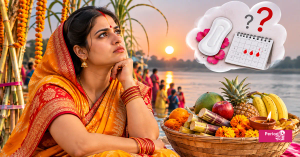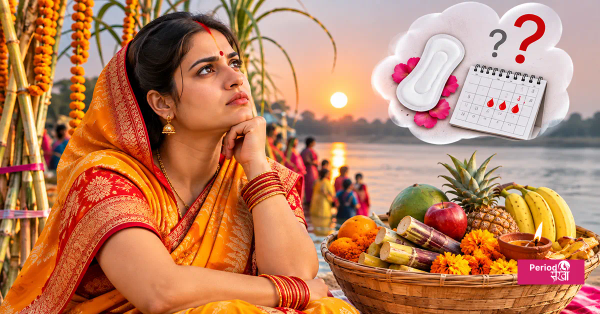

There is something deeply moving about Chhath Puja. The sound of traditional Chhath songs playing in the neighbourhood, the aroma of freshly prepared thekua, fruits arranged in bamboo baskets, and families gathering at the ghats before sunrise create an atmosphere that is difficult to describe unless you have experienced it. For many people, particularly in Bihar, Jharkhand and eastern Uttar Pradesh, Chhath is not just a religious occasion. It is part of their identity, childhood memories and family traditions. Mothers, grandmothers, daughters and other family members come together to prepare for the festival, often days in advance but there is one question that can make a woman pause during these preparations: What if my period starts just before Chhath?
Can I participate in the rituals? Is it safe to observe a nirjala vrat while menstruating? Should I avoid going to the ghat? Are the restrictions around periods based on medical science or religious customs? These questions are not unusual. Many women grow up hearing different explanations from family members, and the answers can vary between households and communities. Understanding the significance of Chhath and the science of menstruation can help separate religious traditions from medical facts. Faith deserves respect, but a woman's health should never become an afterthought.
It is dedicated to the worship of Surya Dev (the Sun God) and Chhathi Maiya, with prayers for health, prosperity, well-being and the happiness of family members. The festival is traditionally observed on the sixth day of the bright fortnight of the Hindu month of Kartik, usually in October or November. Some communities also observe Chaiti Chhath during the month of Chaitra.
What makes Chhath particularly distinctive is its connection with nature. The Sun is worshipped as the source of light, warmth and energy that sustains life. Devotees offer arghya to both the setting and rising Sun, expressing gratitude not only for what the day brings but also for the cycle of life itself.
Unlike festivals that centre on elaborate temple ceremonies, Chhath is often observed directly at rivers, ponds and other water bodies. Devotees offer prayers without the requirement of a priest, using traditional offerings such as fruits, sugarcane, coconut, thekua and seasonal produce. The four-day observance also involves considerable preparation and discipline. Homes are cleaned, offerings are prepared with care, and families work together to arrange the rituals.
For many families who have moved to Kolkata, Delhi, Mumbai or other parts of India, Chhath becomes a reason to return home. Even when travelling is not possible, people organise celebrations in their neighbourhoods, residential communities and local water bodies.
There are several reasons the festival holds such a special place:
A sense of belonging: Chhath brings together families, neighbours and entire communities, often across generations.
Connection with nature: Worshipping the Sun and offering prayers near water bodies reflects gratitude towards the natural resources that sustain life.
Community participation: People help prepare the ghats, arrange offerings, prepare prasad and support families observing the vrat.
Cultural continuity: Traditional folk songs, recipes and rituals are passed from mothers and grandmothers to younger generations.
Simplicity and equality: The offerings are often locally available foods, and the central act of worship is direct and accessible to devotees.
The sight of hundreds of people standing together at a riverbank, waiting for the first rays of sunlight, is a reminder of how a shared tradition can bring people together.
For many devotees, Chhath Puja is incomplete without remembering Chhathi Maiya. Chhathi Maiya is commonly associated with Shashthi Devi, a mother goddess traditionally connected with the protection of children, fertility and family well-being. In regional devotional traditions, she is also described as the sister of Surya Dev.
Her significance is particularly meaningful for women and families who pray for the health and long life of their children and the well-being of their loved ones. Chhathi Maiya also represents something that goes beyond the fulfilment of wishes: strength through devotion and discipline.
Consider the women who prepare for Chhath. They may spend days arranging the ingredients, preparing prasad, maintaining household rituals and observing a demanding fast. Many wake before dawn, travel to the ghats and stand in water while offering prayers to the Sun.
Their dedication reflects patience, commitment and an extraordinary sense of responsibility towards their families and beliefs. Chhathi Maiya can therefore be understood, through a contemporary lens, as a symbol of feminine strength, nurturing and resilience. She represents the idea of a mother who protects, sustains and wishes well for those she loves.
However, strength should not be measured by how much physical discomfort a woman can tolerate. A woman who needs rest, medical care or a modification to her fast is not less devoted. Looking after one's health is also an expression of responsibility. This distinction becomes especially important when menstruation coincides with Chhath.
Before discussing periods and the vrat, it helps to understand what the observance involves.
Day | Ritual | What happens? |
|---|---|---|
Day 1: Nahay Khay | Bathing and eating | Devotees take a ritual bath and prepare a simple, traditionally pure meal |
Day 2: Kharna | Preparation for the main fast | Devotees observe a fast during the day and break it after evening prayers with offerings such as kheer and roti |
Day 3: Sandhya Arghya | Evening offering | Devotees gather at water bodies and offer arghya to the setting Sun |
Day 4: Usha Arghya | Morning offering | Prayers are offered to the rising Sun, after which the fast is concluded |
After Kharna, many devotees undertake a prolonged nirjala fast, traditionally lasting around 36 hours, without food or water until the morning arghya is completed. Practices and the exact duration can vary between families and communities. This is a demanding observance. It requires preparation, physical stamina and careful attention to health.
This is perhaps the most sensitive question for women who menstruate.
In several traditional households, menstruating women are asked not to perform certain rituals, touch the prasad or participate directly in the puja. Some families follow restrictions on entering the prayer area or visiting the ghat. These practices are rooted in religious and cultural interpretations, and they differ across communities. There is no single rule followed by every Chhath-observing family. From a medical perspective, however, menstruation is a normal biological process, not an illness or a state of physical contamination.
During menstruation, the uterus sheds its inner lining, which leaves the body through the vagina as menstrual blood. This process does not make a woman dirty, harmful or medically incapable of participating in ordinary activities.
There is no medical evidence that menstrual blood contaminates food, prasad, water or religious offerings simply because a menstruating woman handles them.
The distinction is important:
A family may follow a religious custom that restricts participation during menstruation.
Such a custom should not be presented as a medical necessity.
A woman may choose to follow her family's religious practice without believing that her body is unclean.
Menstruation alone does not make ordinary physical activity unsafe.
The World Health Organization recognises menstrual health as part of overall health and emphasises that people should be able to manage menstruation with dignity and without stigma. Ultimately, decisions about religious participation may depend on personal belief and family tradition. Medical decisions, however, should be guided by health needs rather than fear or misinformation.
This question needs more attention than a simple yes or no.
Menstruation itself is not a medical condition that automatically prevents someone from fasting. However, the physical demands of a prolonged fast without water can create health risks, whether a person is menstruating or not. During menstruation, some women experience cramps, headaches, nausea, fatigue or dizziness. Others have very little discomfort and continue their usual routines. A nirjala fast can add another physical challenge because the body receives no fluids for an extended period.
The body continuously loses water through urine, sweat, breathing and bowel movements. When fluid intake stops, this loss can lead to dehydration.
Common signs include:
Excessive thirst and dry mouth.
Headache and unusual tiredness.
Dark yellow urine or passing urine less frequently.
Dizziness, particularly when standing.
Light-headedness and difficulty concentrating.
Prolonged fluid restriction can be particularly concerning if someone is already unwell, has been exposed to heat or has a medical condition that affects fluid balance.
Not necessarily for every woman. A normal menstrual period does not automatically cause dehydration or make fasting unsafe. However, women with heavy menstrual bleeding may be more vulnerable to fatigue and iron-deficiency anaemia. If they are already experiencing weakness, dizziness or breathlessness, adding a prolonged fast without water may worsen how they feel. A woman who has painful periods, vomiting, diarrhoea or an underlying medical condition should be particularly cautious.
The key point: The safety of fasting depends on the individual's health, symptoms, hydration status and medical history. It should not be judged by whether she is menstruating alone.
Health situation | Why extra caution is needed |
|---|---|
Heavy menstrual bleeding | May contribute to iron deficiency and fatigue |
Severe period cramps | Pain, nausea or vomiting may make fasting harder to tolerate |
Diabetes | Prolonged fasting can affect blood glucose levels and medication requirements |
Kidney or heart conditions | Fluid restriction may be unsafe depending on the condition |
Fever, vomiting or diarrhoea | Increases the risk of dehydration |
Pregnancy | Fasting without water may pose risks and requires medical guidance |
Breastfeeding | Fluid and nutritional requirements may be higher |
History of fainting or anaemia | Prolonged fasting may worsen symptoms or increase the risk of feeling unwell |
If you have any of these conditions, discuss fasting with your healthcare professional beforehand. Do not stop prescribed medication or change its timing without medical advice.
For women who choose to participate in Chhath-related activities during menstruation, practical menstrual hygiene is important.
The festival often involves travelling to ghats, spending time outdoors and standing near water bodies. Access to clean toilets, private changing facilities and disposal bins may be limited in crowded areas.
Planning ahead can make the experience more comfortable.
There is no single menstrual product that every woman must use. Pads, tampons, menstrual cups and period underwear are options, depending on personal preference and comfort.
Menstrual product | Practical consideration during Chhath |
|---|---|
Sanitary pads | Carry extra pads and change them regularly, ideally with access to a clean, private toilet |
Tampons | Change according to product instructions and never leave one in longer than recommended |
Menstrual cups | Empty, clean and reinsert according to the manufacturer's instructions; clean hands are essential |
Period underwear | Carry a spare pair and ensure used clothing can be changed and stored hygienically |
If you are using a menstrual cup or tampon for the first time, Chhath may not be the best occasion to experiment with a new product. Familiarity and comfort matter, especially when facilities are limited.
Wash your hands before and after changing menstrual products.
Carry tissues, a small bag for used products and hand sanitiser.
Use clean, private facilities wherever available.
Dispose of used pads and tampons responsibly; do not leave them near water bodies.
Avoid using river or pond water to clean menstrual products or wash the genital area.
Wear comfortable clothing that allows easy movement.
Menstrual hygiene is not only about preventing discomfort. It also protects dignity, privacy and general health.
Many beliefs around menstruation have been passed down through generations. Some are religious customs, while others are presented as medical facts despite having no scientific basis.
It helps to understand the difference.
Common belief | What medical science says |
|---|---|
Menstrual blood is impure or harmful | Menstrual blood is a mixture of blood and uterine tissue. It is not poisonous or inherently harmful |
A menstruating woman contaminates prasad | There is no medical evidence that menstruation makes food or offerings unsafe |
Women cannot stand in water during periods | Menstruation itself does not make standing in water medically unsafe; water quality, temperature, footing and personal comfort matter |
Fasting during periods is always dangerous | Menstruation alone does not make every fast unsafe, but prolonged fasting without water can carry significant risks |
Periods make women physically weak or incapable | Menstruation affects people differently. Many continue their usual activities, while others need rest or pain relief |
Taking a bath during periods is harmful | Bathing during menstruation is safe and supports personal hygiene |
A woman who gets her period during Chhath has done something wrong | Menstruation is a natural bodily process and cannot be controlled through religious intention or effort |
Religious customs may have meaning within a family or community. But they should not be used to make women feel ashamed of a normal biological process.
It can be stressful when menstruation begins unexpectedly, particularly after days of preparation.
Perhaps you have helped clean the house, prepare the offerings and arrange everything for the festival. You may have planned to participate in the evening arghya, only to find that your period has started.
First, remember that menstruation is not something you have done wrong. It is a biological process, and its timing is not under voluntary control.
You can consider the following:
Talk to your family. Explain how you feel and understand the customs followed in your household. Religious practices differ, and a respectful conversation can help avoid unnecessary guilt or pressure.
Decide what participation means to you. Depending on your beliefs and family traditions, you may choose to attend the celebrations, help with preparations, offer support to the person observing the vrat or follow specific ritual restrictions.
Do not ignore your health. If you have severe cramps, heavy bleeding, dizziness or unusual weakness, prioritise rest and medical care.
Avoid forcing yourself to fast. If you have a health condition or symptoms that make a nirjala fast unsafe, discuss a safer approach with your family and a healthcare professional. Religious observances should not require you to conceal illness or put yourself at risk.
A period arriving during Chhath does not take away your devotion or the love you have for the festival.
Chhath is often described as a festival of collective devotion. Its preparations already involve the contribution of several family members, neighbours and community groups.
That same spirit can extend to menstrual health.
Families can make the festival more comfortable by:
Keeping clean toilets and changing facilities accessible at the ghats.
Providing covered bins or appropriate disposal arrangements for menstrual products.
Avoiding comments that make girls or women feel ashamed of menstruation.
Allowing women with severe cramps or other symptoms to rest.
Making sure that fasting is voluntary and not imposed through pressure.
Supporting women who need medical care or a modification to their usual routine.
Young girls who are menstruating for the first time may have questions or feel embarrassed. A calm explanation from a parent, sibling or trusted family member can make a meaningful difference.
Chhath is passed from one generation to another. Along with songs, rituals and recipes, accurate information about health can also become part of that tradition.
1. Can I attend Chhath Puja if I am on my period?
From a medical perspective, menstruation does not prevent you from attending a public gathering or performing ordinary activities. However, some families follow religious restrictions on ritual participation. These practices vary, so your decision may depend on your personal beliefs and family customs.
2. Can I touch Chhath prasad during menstruation?
There is no medical evidence that menstrual blood makes prasad unsafe or contaminated. Any restriction on handling offerings is a matter of religious or family tradition, not a medical hygiene requirement.
3. Can I observe the 36-hour nirjala vrat during periods?
Menstruation alone does not automatically make fasting unsafe. However, a prolonged fast without water can cause dehydration and may be particularly risky for women with heavy bleeding, anaemia, diabetes or other health conditions. Seek medical advice if you have any relevant symptoms or medical history.
4. Can period cramps become worse during Chhath fasting?
Some women may experience greater discomfort when fasting, especially if they are tired, dehydrated or unable to take their usual pain medication. The effect varies between individuals. Do not ignore severe pain or dizziness.
5. Is it safe to stand in river water during menstruation?
Menstruation itself does not make standing in water unsafe. However, the cleanliness of the water, the condition of the ghat, slippery surfaces and the availability of clean facilities should be considered. Avoid entering water that may be contaminated or unsafe.
6. Should I stop taking my regular medicines during Chhath?
No. Do not stop prescribed medicines or change their timing simply to observe the fast. Speak to your healthcare professional about whether fasting is appropriate with your treatment.
7. Does getting periods during Chhath mean the vrat has been broken?
There is no medical interpretation of a period as a failure of a religious fast. Menstruation is involuntary. How a family interprets ritual observance depends on its religious tradition, but a woman should not be made to feel guilty for a natural bodily process.
Chhath Puja is a celebration of gratitude, nature, discipline and devotion. Chhathi Maiya is remembered with love and reverence by countless families, particularly women who have grown up watching their mothers and grandmothers observe the festival but devotion should never be confused with physical suffering, and menstruation should never be treated as a personal failing.
A woman may choose to follow her family's religious customs during her period. She may also choose to participate in the celebrations according to her beliefs. What matters is that the decision is informed, respectful and free from shame or pressure. A demanding nirjala fast is not suitable for everyone, and medical conditions or warning symptoms should never be ignored. Perhaps the most meaningful way to carry a tradition forward is to preserve its faith while making space for compassion, health and understanding.
About PeriodSakhi
PeriodSakhi is your trusted companion for understanding your menstrual health. With easy-to-use tools, it helps you track your periods, ovulation, fertility, moods, and symptoms, while providing insights into your overall reproductive and hormonal health. PeriodSakhi also serves as a supportive online community where women can share experiences, find reliable information, and access expert-backed guidance on menstrual health, PCOS, pregnancy, lifestyle, and more.
Disclaimer
The views, thoughts, and opinions expressed in this article/blog are solely those of the author and do not necessarily reflect the views of PeriodSakhi. Any omissions, errors, or inaccuracies are the responsibility of the author. PeriodSakhi assumes no liability or responsibility for any content presented. Always consult a qualified medical professional for specific advice related to menstrual health, fertility, pregnancy, or related conditions.