
“Caring for myself is not self-indulgence, it is self-preservation.” — Audre Lorde
For a long time, conversations about periods begin and end with one thing: cramps.
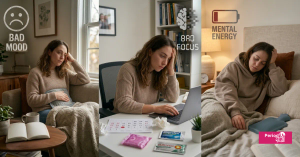
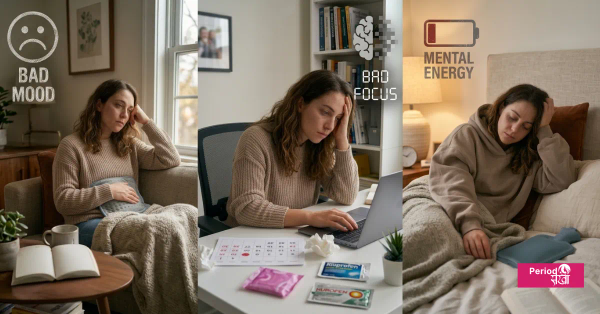
Take a painkiller. Use a hot-water bottle. Rest for a while. And then get back to normal but periods are not only about pain. Some people notice that their mood changes before their period. Some feel unusually tired. Some find it harder to concentrate at work or study. Others feel more sensitive, anxious, irritable or emotionally drained. Some sleep poorly and then spend the next day trying to function with very little mental energy.
These experiences are real, but they do not happen to everyone in the same way. The menstrual cycle is a natural process controlled by changing levels of hormones, mainly oestrogen and progesterone. These hormones do much more than control the uterus. They interact with the brain, sleep, appetite, energy and emotional health too. This does not mean that every mood change is “because of hormones”. Stress, workload, relationships, sleep, nutrition and existing mental health conditions also matter but understanding the menstrual cycle can help us notice one important thing: period health is also mental and emotional health.
We often talk about menstruation as if it is a single event but the menstrual cycle is a whole process.
Hormone levels rise and fall throughout the cycle. During the first part of the cycle, oestrogen gradually rises and the uterine lining starts preparing for a possible pregnancy. Around ovulation, hormonal changes take place. After ovulation, progesterone becomes more prominent. If pregnancy does not occur, hormone levels fall and menstruation begins.
These changes can affect people differently. Some people notice very little difference from one phase to another. Others notice clear changes in their energy, appetite, sleep, mood or concentration.
That is why saying “It is just your period” can be so dismissive. The cycle can influence how someone feels, but the experience is personal.
Imagine sitting in front of your laptop.
The work is not particularly difficult. You understand what you have to do. But your mind feels slower than usual. You read the same sentence twice. You open an email and forget what you wanted to reply. You start one task, check another, and then struggle to return to the first one.
For some people, this happens around their period.
Pain itself can make concentration harder. A 2024 pilot study found that people with primary dysmenorrhoea showed lower performance in some areas of cognition, including attention, processing speed and cognitive control, on their most painful day compared with a pain-free day.
Research among students also shows that period pain can affect concentration and academic performance. A systematic review of more than 21,000 young women found that about 41% reported that dysmenorrhoea negatively affected classroom performance or concentration.
This does not mean that the menstrual cycle makes someone less capable.
It means that working while dealing with pain, fatigue or other symptoms can use up mental energy that would otherwise go towards the task.
The answer is not one single hormone.
The menstrual cycle involves changes in several hormones and brain signalling systems. Oestrogen and progesterone interact with systems involved in mood, sleep and emotional regulation.
Then there is pain. During menstruation, the uterus produces substances called prostaglandins. They help the uterus contract so that the uterine lining can be shed. Higher prostaglandin activity is linked with stronger menstrual cramps in some people. Pain takes attention. When the brain is constantly receiving pain signals, concentrating on a presentation, studying for an examination or completing a spreadsheet can become harder. Then there is sleep.
Cramps, bloating, headaches, mood changes or discomfort can disturb sleep. Poor sleep can leave someone tired, less focused and more emotionally reactive the next day. So, what looks like “poor concentration” may actually be a combination of pain + poor sleep + hormonal changes + emotional stress + fatigue.
Before a period, some people experience symptoms such as irritability, anxiety, sadness, crying spells, social withdrawal, confusion or difficulty concentrating.
These can be part of premenstrual syndrome, or PMS, particularly when they happen repeatedly and interfere with everyday life.
For some people, symptoms are much more severe.
Premenstrual dysphoric disorder (PMDD) is a more severe condition in which emotional and physical symptoms can significantly affect daily life and relationships. It is different from simply having a bad mood before a period. This distinction matters. We should not call every difficult emotion “PMS”. At the same time, we should not dismiss recurring and disabling symptoms as someone being “too emotional”. Both extremes can be harmful.
This is an important part of menstrual education.
A person can feel sad because they are going through a difficult week.
They can be anxious because of an upcoming examination.
They can be irritated because they have slept four hours.
They can experience depression or anxiety that continues throughout the month.
And yes, hormonal changes around the menstrual cycle can also contribute to symptoms in some people.
The key is pattern.
If mood changes repeatedly appear in the days before menstruation and improve afterwards, tracking symptoms for a few cycles can help identify a pattern.
If low mood, anxiety or loss of interest continues throughout the month, it deserves proper medical attention rather than simply being labelled “period mood”.
For generations, many people grew up with one message about periods:
Hide it.
Hide the pad.
Hide the blood.
Hide the pain.
Do not talk about it at school.
Do not mention it at work.
And definitely do not tell anyone that you are struggling.
This silence has consequences.
The World Health Organization now describes menstrual health as more than access to menstrual products. It includes accurate information, access to care, freedom from stigma and the ability to participate in daily life with dignity.
UNICEF India also notes that attitudes towards menstruation are changing, while pointing out that Indian communities still have very different experiences from restrictions and taboos to more open conversations about menstruation.
The conversation is changing.
Slowly, but visibly.
Earlier, a girl struggling to concentrate during an examination might simply be told to “adjust”.
A woman who needed to sit down at work because of severe cramps might worry that colleagues would think she was making excuses.
A partner might not understand why someone wants quiet, rest or emotional space around certain days of the month.
Today, education is helping change that language.
Instead of:
“She is being dramatic.”
“Everyone gets periods.”
“Just take a tablet.”
“You came to work, so you should be fine.”
“It is only a few days.”
We are beginning to ask:
How severe is the pain?
Is this happening every month?
Is it affecting sleep?
Is concentration becoming difficult?
Is heavy bleeding making daily life harder?
Does this need medical care?
What support would actually help?
That is a much healthier conversation.
Imagine a teenager sitting in a classroom with cramps.
The teacher is explaining an important concept. The student is trying to listen, but her lower abdomen hurts. She has changed her pad and is worried about leakage. She feels tired because she slept badly.
She may be physically present but mentally somewhere else.
Research shows that dysmenorrhoea can affect school attendance and concentration. In the large systematic review of young women, around one in five reported missing school or university because of period pain.
This is why menstrual education should not be limited to teaching girls what a pad is.
Young people also need to understand:
What is normal? What is not? When should I ask for help?
And boys need to learn this too.
Because menstrual health is not a “girls-only” topic.
A person can be sitting at their desk and still be struggling.
This is called presenteeism being present at work while health symptoms reduce how effectively you can function. Studies among working women have found associations between menstrual symptoms, pain and reduced work productivity. An Australian study of women aged 18–39 found that those reporting moderate-to-severe dysmenorrhoea were more likely to report poorer work performance and more sick leave.
More recent research also suggests that menstrual symptoms beyond pain such as negative mood and impaired concentration can be associated with work impairment and quality of life.
This changes the question.
Instead of asking:
“Why did she take a day off?”
We can ask:
“What is making it difficult for people to work comfortably and effectively?”
Sometimes the answer is surprisingly simple: access to a washroom, menstrual products, a place to rest, flexible working hours or simply a workplace culture where people do not feel ashamed.
Menstrual education also changes relationships.
A friend may learn that her friend does not need advice every time she says she is in pain. Sometimes she just needs someone to say, “Do you want me to stay with you?”
A partner may understand that emotional sensitivity around the premenstrual phase is not necessarily anger directed at them.
But understanding does not mean excusing every hurtful behaviour.
It means learning to communicate better.
Instead of guessing, ask:
“How are you feeling today?”
Instead of saying:
“You are only saying this because you are on your period.”
Try:
“Is there anything I can do that would make today easier?”
That small change can make a relationship feel much safer.
The conversation around menstrual leave is growing in India and around the world.
But menstrual support does not have to mean one single policy.
Different people need different things.
Some may need a day off.
Some may need flexible hours.
Some may need the option to work from home.
Some may simply need access to pain relief, clean washrooms and menstrual products.
And some may need medical care for a condition such as endometriosis, fibroids, severe dysmenorrhoea or PMDD.
There is no single solution for everyone.
The goal is not to treat menstruation as a weakness.
The goal is to make sure that having a menstrual cycle does not become a reason to lose dignity, education, income or opportunity.
Menstrual health education can start with very ordinary actions.
Menstruation should not be explained only after someone gets their first period.
Children can learn age-appropriate information about puberty, body changes and hygiene beforehand.
Education should include cramps, headaches, fatigue, mood changes, sleep problems and heavy bleeding.
Severe pain that repeatedly interferes with school, work or daily life should not simply be accepted as something everyone has to tolerate.
The WHO also identifies severe pain, heavy bleeding and significant mood symptoms as reasons to seek health care.
Understanding reduces awkwardness.
A brother who knows what menstruation is may become more supportive.
A male teacher who understands menstrual health may respond differently to a student asking to leave the classroom.
A partner who understands the cycle can communicate better.
A period-friendly workplace does not need to be complicated.
Clean washrooms, easy access to menstrual products, flexibility when needed and a respectful culture can make a meaningful difference.
For a long time, menstruation was presented as something to manage quietly.
Now, menstrual health education is becoming broader.
It is about menarche, periods, contraception, fertility, pregnancy, menopause, pain, mental health and knowing when something is not normal.
It is also about conversations.
Books, schools, healthcare professionals, social media, community programmes and menstrual-health platforms are all helping bring the subject into everyday language.
Platforms such as PeriodSakhi can become part of this change by making menstrual information easier to understand and easier to share with young people, parents, partners, teachers and communities.
The important part is not simply giving someone more information.
It is helping them turn information into confidence:
“I know what is happening to my body.”
“I know what I can do about it.”
“I know when I need help.”
And perhaps most importantly:
“I do not have to be ashamed of asking.”
Listen to the body, not the stigma
There is no perfect menstrual cycle.
Some months feel easy.
Some months feel exhausting.
Some people experience almost no symptoms. Others experience pain, heavy bleeding, headaches, mood changes or fatigue that genuinely affects daily life.
The menstrual cycle is one part of a person’s health not their entire identity and certainly not a measure of their ability. We are learning to move beyond the old idea that people should simply tolerate period pain in silence. We are also learning something bigger.
A healthy conversation about menstruation is not only about pads and cramps. It is about mental energy, dignity, relationships, education, work and the freedom to participate in life.
The more we understand the science, the less we have to rely on shame and assumptions and perhaps that is where real menstrual health begins not when someone gets their first period, but when they learn that their body deserves to be understood.
World Health Organization. Menstrual health. WHO, 2026.
American College of Obstetricians and Gynecologists. Premenstrual Syndrome (PMS).
American College of Obstetricians and Gynecologists. What I Wish Everyone Knew About Premenstrual Dysphoric Disorder. 2024.
Armour M, et al. The Prevalence and Academic Impact of Dysmenorrhea in 21,573 Young Women: A Systematic Review and Meta-Analysis. Journal of Women’s Health.
A pilot longitudinal study of decrease in cognitive functions during the most painful day of the period among women with primary dysmenorrhea. Archives of Gynecology and Obstetrics, 2024.
Dysmenorrhea, Workability, and Absenteeism in Australian Women. Journal of Women’s Health, 2023.
UNICEF India. Challenging to Championing: My Menstruation Journey. 2024.
Beyond Pain—Associations Between Menstrual Symptoms, Work Productivity and Quality of Life. 2026.
About PeriodSakhi
PeriodSakhi is your trusted companion for understanding your menstrual health. With easy-to-use tools, it helps you track your periods, ovulation, fertility, moods, and symptoms, while providing insights into your overall reproductive and hormonal health. PeriodSakhi also serves as a supportive online community where women can share experiences, find reliable information, and access expert-backed guidance on menstrual health, PCOS, pregnancy, lifestyle, and more.
Disclaimer
The views, thoughts, and opinions expressed in this article/blog are solely those of the author and do not necessarily reflect the views of PeriodSakhi. Any omissions, errors, or inaccuracies are the responsibility of the author. PeriodSakhi assumes no liability or responsibility for any content presented. Always consult a qualified medical professional for specific advice related to menstrual health, fertility, pregnancy, or related conditions.