
You have just returned from college. You are hungry, your lunch is waiting, and all you want is a plate of rice, dal and your favourite sabzi. But just before you take the first bite, a familiar thought crosses your mind: Is this too much rice? Should I eat less?
If this sounds familiar, you are certainly not alone.
Healthy eating has often been presented as a list of things we should stop eating. Rice is reduced, roti is counted, and our favourite snacks are suddenly labelled as unhealthy. Before we know it, eating has become a task that requires constant calculations.
A balanced diet does not have to work that way. Your body needs food for energy, concentration, movement and everyday functioning. The aim is not to eat as little as possible. It is to understand how much food satisfies your hunger, provides essential nutrients and fits comfortably into your daily routine. This is where portion control becomes useful.
A portion is the amount of food you choose to eat at one time. Portion control simply means becoming more aware of that amount. It is not the same as restricting food or following a weight-loss diet. You may have noticed that food packets mention a serving size. This is a reference amount used on the label, whereas your portion is the amount you actually eat. The two do not always match. Portion sizes can influence how much we eat.
Research has shown that larger portions tend to encourage greater food intake, even when people do not consciously intend to eat more. This is one reason why being aware of portion sizes can be helpful. However, the amount of food you need is not fixed. It changes with your age, activity level, appetite and nutritional requirements. The goal is to find a balance that works for your body, rather than following a rigid set of rules.
One of the simplest ways to plan a meal is to use the healthy plate approach.
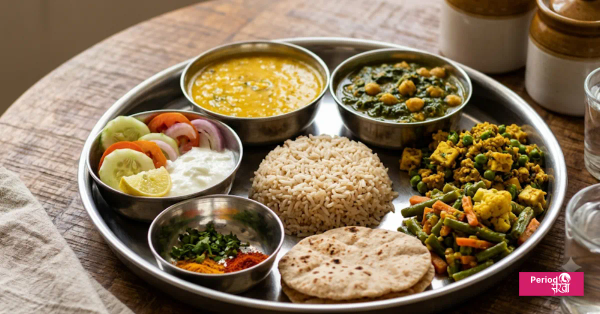
Instead of counting every calorie, imagine dividing your plate into three sections.
Part of your plate | What to include |
|---|---|
Half the plate | Vegetables and other fibre-rich foods |
One-quarter | Protein-rich foods |
One-quarter | Carbohydrate-rich foods |
This is a visual guide, not a strict prescription. Your nutritional needs may require different proportions, and your meals do not have to look identical every day.
For an Indian meal, this could mean adding bhindi, cabbage, carrots or spinach to one half of your plate. Dal, rajma, chana, eggs, chicken, fish or tofu can provide protein. Rice, roti, potatoes or other grains can supply carbohydrates. A plate of rice, dal and sabzi can be just as balanced as a meal containing grilled chicken and vegetables. The ingredients may differ, but the idea is the same: include a variety of foods that provide different nutrients and no, rice does not need to be removed from your plate. It provides carbohydrates, which are an important source of energy for your body and brain.
Measuring every ingredient is not always practical. If you live in a hostel, eat at a college canteen or prepare meals between classes, a weighing scale may be the last thing you want to carry around.
Your hands can offer a convenient visual guide.
Food group | Approximate visual guide |
|---|---|
Vegetables | Two cupped hands |
Rice or other grains | One cupped hand |
Protein-rich foods | One palm |
Nuts or concentrated fats | One thumb |
These are approximate starting points, not exact nutritional requirements. Your needs may be different depending on your activity, appetite and health.
For instance, if you have spent the morning walking across campus, you may feel hungrier than you would after a quiet day at home. Both situations are normal.
The guide is meant to make meals easier to understand, not to turn eating into another examination.
Imagine being told that you cannot eat chocolate, pizza, momos or your favourite dessert ever again.
It sounds exhausting, doesn't it? When certain foods are completely forbidden, eating can become stressful. You may find yourself thinking about them more often or feeling guilty when you eventually have them. A more sustainable approach is to include your favourite foods in a balanced eating pattern.
You can enjoy biryani with raita and vegetables. A samosa can be enjoyed alongside your usual meals. A few pieces of chocolate can be part of your day without becoming a reason to feel guilty. The overall pattern of your diet matters more than any single food.
Small additions can also make familiar meals more balanced. You could add vegetables to your noodles, include curd with rice or pair a sandwich with fruit. You do not have to give up the foods you love to take better care of yourself.
Hunger and fullness are natural signals. Yet, when we become busy with college, work or daily responsibilities, these signals can easily be overlooked.
Hunger may show up as a growling stomach, low energy or difficulty concentrating. Fullness may feel like a comfortable sense of satisfaction rather than the uncomfortable feeling of being stuffed.
Try to slow down while eating. Put your phone aside for a few minutes, chew comfortably and notice how you feel as the meal progresses.
You do not have to stop eating at the first sign of fullness. If you are still hungry, it is perfectly fine to have more food.
A second helping of dal, another roti or some additional rice may be exactly what your body needs.
Eating slowly may help you recognise hunger and fullness cues, but appetite is influenced by several factors, including sleep, stress, physical activity and hormones.
Your body does not follow the same schedule every day, and your meals do not have to either.
Healthy eating becomes much easier when it fits into your actual routine.
If you have early lectures, a long commute or back-to-back classes, you may not always have the opportunity to sit down for a proper meal.
A few simple habits can help.
Keep convenient snacks within reach. A banana, roasted chana, nuts, boiled eggs or a simple sandwich can be useful when you need something between meals.
Avoid ignoring hunger for too long. Going for long periods without eating may leave you extremely hungry later. Regular meals or snacks can help if they suit your schedule and appetite.
Serve snacks into a bowl. Eating directly from a large packet can make it harder to notice how much you have eaten. A bowl gives you a clearer idea of the amount.
Make room for flexibility. Some days will be more active than others. Your appetite may change, and your meals can change with it.
There is no universal rule that everyone must eat three meals or six small meals a day. The best routine is one that meets your needs and can be maintained comfortably.
For women who menstruate, appetite and food preferences may change throughout the menstrual cycle.
Some women feel hungrier in the days before their period. Others notice stronger cravings for sweet or savoury foods. Some experience very little change.
All these experiences can be normal. Hormonal changes during the menstrual cycle may influence appetite, energy needs and food preferences. Research suggests that energy intake can be higher during the luteal phase, which occurs after ovulation and before menstruation. However, the extent of these changes varies considerably between individuals.
This is one reason why a rigid meal plan may become frustrating. You may feel satisfied with your usual lunch one week and need a little more food the next. That does not automatically mean you have lost control of your eating habits. Instead of forcing yourself to follow the same portions every day, pay attention to your hunger.
During menstruation, a balanced diet can also help support your general nutritional needs. Iron is particularly important because menstrual bleeding contributes to iron loss. Foods such as dal, beans, leafy vegetables, eggs, fish and meat can provide iron. Vitamin C-rich foods, such as lemon, guava and amla, can improve the absorption of iron from plant-based foods when eaten together.
For example, adding lemon to a bowl of chana or enjoying amla alongside a meal can be a simple way to improve iron absorption. However, food alone may not be sufficient if you have iron deficiency. Persistent fatigue, dizziness or unusually heavy menstrual bleeding should be discussed with a healthcare professional. Most importantly, portion control should never mean ignoring genuine hunger, particularly when you are experiencing menstrual discomfort or fatigue.
You do not have to change your entire eating routine overnight. Start with one habit. Add a vegetable to lunch. Keep a convenient snack in your college bag. Take a few minutes to enjoy your meal without distractions. Over time, these small changes can become part of your everyday routine. Portion control is not about having less food, less pleasure or less freedom at the dining table. It is about understanding your body's needs and making room for different foods in a way that feels sustainable.
Some days, you may want an extra roti. On others, you may feel satisfied with a smaller meal. You may enjoy a home-cooked lunch on Monday and order your favourite pizza on Friday. None of these choices needs to come with guilt.
If you are unsure about how much food you need, or if you experience persistent fatigue, unexplained weight changes, irregular periods or concerns about your relationship with food, consult a registered dietitian. A dietitian can help you understand your nutritional requirements and develop an eating plan that is practical, balanced and appropriate for your health.
For menstrual health information, PeriodSakhi offers a platform to learn about the menstrual cycle, nutrition, period-related symptoms and everyday wellbeing. Understanding how appetite, cravings and energy levels may change throughout the cycle can help women make more informed food choices without unnecessary restrictions because eating well should not feel like a punishment. It should feel like taking care of yourself, one satisfying meal at a time.
Dr. Akanksha is a dedicated dental professional and health educator who believes that healthcare goes beyond treatment-it is about creating awareness, building trust, and empowering individuals to make informed decisions about their well-being. Alongside her clinical expertise in dentistry, she is deeply passionate about public health education, with a special focus on menstrual health, hygiene, and women's wellness.
About PeriodSakhi
PeriodSakhi is your trusted companion for understanding your menstrual health. With easy-to-use tools, it helps you track your periods, ovulation, fertility, moods, and symptoms, while providing insights into your overall reproductive and hormonal health. PeriodSakhi also serves as a supportive online community where women can share experiences, find reliable information, and access expert-backed guidance on menstrual health, PCOS, pregnancy, lifestyle, and more.
Disclaimer
The views, thoughts, and opinions expressed in this article/blog are solely those of the author and do not necessarily reflect the views of PeriodSakhi. Any omissions, errors, or inaccuracies are the responsibility of the author. PeriodSakhi assumes no liability or responsibility for any content presented. Always consult a qualified medical professional for specific advice related to menstrual health, fertility, pregnancy, or related conditions.