
Imagine this: Your period has its own timetable
It is Monday morning. Ananya has an important school assembly, a three-hour examination and a bus ride home. Her period started yesterday, so she slips one pad into her bag and leaves.
By lunchtime, she realises she has a problem. Her bleeding is heavier than she expected, the school toilet has no sanitary pads, and she is too embarrassed to ask her teacher for help.
Now imagine a different situation. Meera is on Day 5 of her period. Her bleeding is barely there, so she decides she no longer needs protection. On her way home from work, she notices a small stain on her trousers.
Two different days. Two different problems. And one useful lesson: the protection you need on the first day of your period may not be the same as what you need a few days later.
Your menstrual flow can change throughout your period. Your plans, however, do not always change with it. Classes continue, office meetings happen, trains get crowded, and public toilets are not always as convenient as they should be.
“Wait, my period was supposed to come tomorrow!”
This is a familiar thought for many people. Even if your cycle is usually regular, your period may arrive a little earlier or later than expected.
Imagine you are sitting in a lecture hall. You have a two-hour class ahead, and you notice the first signs of bleeding. You may not know whether it will remain light or become heavier later in the day.
The sensible approach is to carry a fresh pad and use protection that feels comfortable for the amount of bleeding you are experiencing. If your periods tend to become heavier quickly, planning for that possibility can help you avoid an uncomfortable dash to the washroom.
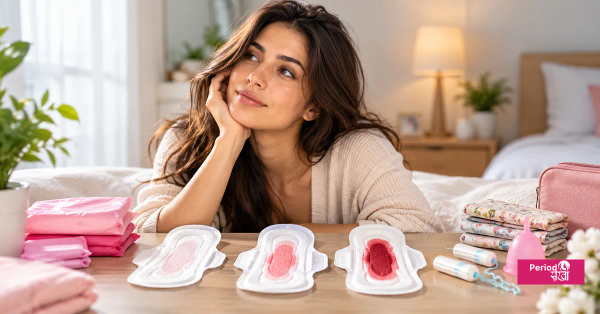
A pad works by absorbing menstrual fluid after it leaves the vagina. Its absorbency, shape and fit affect how well it manages the flow. A pad that is suitable for a few spots may not be enough if bleeding increases.
A small Day 1 habit: Keep one or two spare pads in a clean pouch, along with spare underwear if you have room. If your cycle is unpredictable, leaving a spare in your everyday bag can be useful.
And if this is your first period, remember that it can take time to understand your pattern. The NHS recommends being prepared with menstrual products and asking a trusted adult, teacher or school nurse for help if you need supplies at school.
Day 2 can be a heavier day for some people. The NHS notes that menstrual bleeding is often heaviest during the first two days, although this pattern is not identical for everyone.
Picture Rhea, a college student travelling across the city. She has a practical examination in the morning, lunch with friends and a crowded metro ride in the evening. She cannot simply return home whenever she wants.
What should she do?
First, she should choose a pad that suits her current flow rather than relying on yesterday's experience. If she usually bleeds more heavily on the second day, she can plan for that by carrying additional products and identifying a convenient time to change.
Second, she should not wait until a pad feels completely saturated before changing it. A product may feel damp, uncomfortable or poorly positioned before it is fully soaked. A change may also be needed if there is leakage, irritation or a strong unpleasant odour.
Third, she should remember that a longer pad is not a substitute for changing it. An overnight pad may provide extra coverage, but it does not mean she can safely leave it on all day.
There is no universal timetable that works for every person and every pad. The amount of bleeding, the product's instructions and your comfort all matter. Cleveland Clinic advises changing pads regularly; its general guidance is to change pads or liners at least every four to eight hours, while some NHS school-health guidance recommends around every four hours. On heavier days, you may need to change sooner.
The practical rule: Plan a bathroom break during a long day, carry enough supplies for delays and change your pad when your flow or comfort tells you it is time.
Imagine you are at work. You have prepared for an important presentation, and just as you are about to begin, you remember that your pad has been on for several hours.
You glance at the clock. The meeting is expected to last another 90 minutes.
This is where planning becomes more useful than guessing.
If you know that your flow is moderate or still fairly heavy, try to change your pad before the meeting begins. Keep another one accessible in your bag, rather than buried beneath your laptop, charger, notebook and lunch box.
If your flow has reduced, you may find that a different absorbency is more comfortable. But there is no need to switch products simply because the calendar says it is Day 3. Some people continue to bleed heavily; others are already experiencing lighter flow.
The goal is not to follow a strict day-by-day formula. It is to respond to your body. Menstrual blood is not dirty, but a used pad can retain moisture and blood against the skin. Prolonged dampness and friction may contribute to irritation, particularly if your skin is sensitive. If a pad repeatedly causes itching, burning or a rash, consider whether the material or fragrance is irritating your skin and seek medical advice if symptoms persist.
“There's barely anything on my pad. Do I still need one?”
This is the question Kavya asks herself on the fourth morning of her period. She has an eight-hour shift ahead and does not want to wear a bulky pad if she does not need it.
On lighter days, a regular pad may feel unnecessary. A thinner pad or panty liner may be enough for some people, depending on their bleeding and comfort. Others prefer to continue using their usual pad until bleeding stops.
Brown or pink spotting can occur as menstrual bleeding becomes lighter. The colour alone does not tell you whether you need protection; the amount of bleeding and your own comfort are more useful guides.
Now imagine Kavya has decided to go without protection. Halfway through her shift, she notices a small amount of spotting. It is not a medical emergency, but it could have been easier to manage with a spare liner in her bag.
The lesson is simple: lighter bleeding may call for lighter protection, but a lighter day does not always mean a completely blood-free day.
If you use a panty liner, change it when it becomes damp or soiled. Do not wear one continuously just because it is thin and feels barely noticeable.
If bleeding continues longer than usual, keeps returning after your period appears to have ended, or is accompanied by other unusual symptoms, speak to a healthcare professional.
Not everyone's period ends on Day 5. Some periods last longer, and occasional variation can happen. Suppose you are preparing for a family function, a work trip or a day of travel. You expect your period to have finished, but you notice fresh bleeding again. Rather than assuming that you have done something wrong, check what is happening. Is it a little spotting? Is the bleeding similar to your usual flow? Has this happened repeatedly?
You can use appropriate protection while you monitor the pattern. However, if your period regularly lasts more than seven days, you frequently bleed through your clothes or bedding, or you need to change a pad every one to two hours, the NHS recommends seeking medical advice. Heavy bleeding can sometimes lead to iron-deficiency anaemia, which may cause tiredness, weakness or shortness of breath. If you have extremely heavy bleeding with faintness, collapse, severe weakness or difficulty breathing, seek urgent medical care.
Stage of your period | What you might choose | What to remember |
|---|---|---|
Day 1: bleeding begins | A comfortable pad suited to your current flow | Carry a spare because bleeding may increase |
Day 2: often heavier for some people | A higher-absorbency pad if needed | Change according to bleeding and comfort, not just the clock |
Day 3: flow may be changing | Your usual pad or a lighter option | Do not assume everyone becomes lighter on Day 3 |
Day 4–5: often lighter for some people | A thinner pad or liner if suitable | Spotting can still occur |
Day 6 and beyond | Protection according to the amount of bleeding | Seek advice if bleeding is prolonged or unusual |
This is a planning guide, not a medical rule. Your own pattern may be different.
Let's move beyond the bathroom at home.
Imagine a girl sitting for her board examination. She feels that her pad needs changing, but she is worried about asking to leave the examination hall. Or a woman is standing in a long queue at a government office, knowing that the nearest toilet may not have water, a working lock or a bin.
In a crowded railway station, the problem may be different: the toilet exists, but there is no sanitary pad dispenser, the vending machine is empty, or there is nowhere convenient to dispose of a used product.
These situations are not solved simply by telling women to carry extra pads. Preparation helps, but access to safe and usable facilities matters too.
A school, college, workplace, hospital or transport hub should ideally provide:
Clean toilets with doors that lock and enough privacy to change menstrual products.
Reliable access to water and soap for handwashing.
Menstrual products available at an affordable price, with an emergency supply where possible.
Bins or other appropriate disposal facilities, with regular waste collection.
Clear information about whom to approach if products or facilities are unavailable.
These are practical parts of menstrual health. A toilet that exists on paper but cannot be used safely or privately may not meet a person's needs.
There are initiatives aimed at improving access, awareness and facilities, although their reach and implementation can vary between places.
1. The National Menstrual Hygiene Policy for School-Going Girls
India's Ministry of Health and Family Welfare approved the National Menstrual Hygiene Policy for School-Going Girls in November 2024. The policy aims to improve access to safe and affordable menstrual products, strengthen school sanitation facilities, encourage appropriate waste disposal and reduce stigma through education and community engagement.
This is an important step because menstrual health involves more than distributing pads. Students also need information, privacy and facilities that allow them to manage their periods with dignity.
2. Menstrual Hygiene Scheme under the National Health Mission
The National Health Mission supports menstrual hygiene initiatives for adolescent girls, including awareness and access to sanitary napkins in rural areas. ASHA workers have an important role in sharing information and supporting community-level menstrual health activities.
3. Jan Aushadhi Suvidha sanitary napkins
Under the Pradhan Mantri Bhartiya Janaushadhi Pariyojana, Suvidha sanitary napkins are made available through Jan Aushadhi Kendras at a low price. Affordable products can make it easier for women and girls to keep supplies available for school, work and travel.
4. School sanitation and hygiene programmes
UNICEF India highlights the importance of separate toilets, private changing spaces, water, handwashing facilities and safe menstrual waste disposal as part of school water, sanitation and hygiene programmes.
The presence of a policy or programme does not mean every school or public toilet already has these facilities. The real test is what happens when a student needs a pad during an examination or a woman needs a clean place to change while travelling.
Menstrual health initiatives work best when awareness is matched by reliable supplies, usable toilets, trained staff and respectful treatment.
You do not need a large pouch or an expensive collection of products. A small kit can make an unexpected situation much easier to manage.
Consider keeping:
Two or three fresh pads suited to your usual flow.
A spare pair of underwear, if convenient.
A small, clean bag for carrying supplies.
Tissues or wipes for external cleaning when water is unavailable, without using fragranced products inside the vagina.
A separate disposal bag for a used product when a bin is not immediately available.
Wrap used disposable pads and place them in an appropriate bin. Do not flush pads down the toilet, as they can block plumbing. Wash your hands after changing.
If you use reusable pads, follow the manufacturer's washing and drying instructions. Keep clean and used products separate.
And if your period arrives unexpectedly at school or work, ask a trusted teacher, colleague, school nurse or facility staff member for help. Needing a pad is a normal part of life, not something you should have to feel ashamed of.
No single schedule suits every flow and every product. Change your pad regularly and sooner if it becomes wet, uncomfortable, soiled or saturated. Follow product guidance and do not leave a pad on for an extended period simply because your bleeding is light.
Only if your flow calls for it. Some people bleed more heavily during the first two days, but others have a different pattern. Choose based on your actual bleeding, fit and comfort rather than the day number.
A liner may be suitable for very light bleeding or spotting, but it may not provide enough absorbency on heavier days. Change it when damp or soiled and choose a product that manages your flow comfortably.
Ask a teacher, school nurse, trusted adult or school office for help. If your school has no emergency supplies, it is reasonable to raise this with the school administration. Students should be able to manage menstruation without being humiliated or unnecessarily missing class.
Yes. Menstrual flow often changes throughout a period. However, if you repeatedly need to change a pad every one to two hours, bleed through clothes or bedding, or feel unusually tired or short of breath, speak to a healthcare professional.
Choose a product suitable for overnight use, but follow its instructions and consider how much you bleed. If you regularly wake up with leakage or need to change very frequently, reassess the protection you use and seek medical advice if your bleeding is heavy.
Ananya's school assembly, Rhea's examination and Kavya's work shift all have something in common: none of them can be organised around a perfect menstrual timetable.
Your flow may be heavier on one day, lighter on the next and unpredictable in between. Choosing protection is therefore less about following a fixed Day 1, Day 2 or Day 5 rule and more about knowing your pattern, carrying a few essentials and changing products when needed.
But responsibility should not rest on the person menstruating alone. Schools need emergency supplies and private toilets. Workplaces need usable facilities. Public institutions need accessible products, water and appropriate disposal systems.
A spare pad can help you through an unexpected afternoon. A well-equipped toilet can make that afternoon much less stressful for everyone.
Menstrual care should make it easier to attend class, travel, work and take part in everyday life not force anyone to sit through discomfort because a basic facility is missing.
NHS. Periods. https://www.nhs.uk/conditions/periods/
NHS. Period problems. https://www.nhs.uk/conditions/periods/period-problems/
NHS. Starting your periods. https://www.nhs.uk/conditions/periods/starting-periods/
Cleveland Clinic. Menarche (First Period): Overview, Age & What to Expect. https://my.clevelandclinic.org/health/articles/menarche
Ministry of Health and Family Welfare, Government of India. National Menstrual Hygiene Policy for School-Going Girls. https://www.nhm.gov.in/images/pdf/guidelines/index1.php?lang=1&level=3&lid=859&sublinkid=1531
National Health Mission. Menstrual Hygiene Scheme. https://www.nhm.gov.in/index1.php?lang=1&level=3&lid=391&sublinkid=1021
Press Information Bureau, Government of India. Scheme for Promotion of Menstrual Hygiene. https://www.pib.gov.in/Pressreleaseshare.aspx?PRID=1846147&lang=2®=48
UNICEF India. Clean India, Clean Schools: WASH in Schools. https://www.unicef.org/india/clean-india-clean-schools
Disclaimer: This article is for general educational purposes and does not replace individual medical advice.
About PeriodSakhi
PeriodSakhi is your trusted companion for understanding your menstrual health. With easy-to-use tools, it helps you track your periods, ovulation, fertility, moods, and symptoms, while providing insights into your overall reproductive and hormonal health. PeriodSakhi also serves as a supportive online community where women can share experiences, find reliable information, and access expert-backed guidance on menstrual health, PCOS, pregnancy, lifestyle, and more.
Disclaimer
The views, thoughts, and opinions expressed in this article/blog are solely those of the author and do not necessarily reflect the views of PeriodSakhi. Any omissions, errors, or inaccuracies are the responsibility of the author. PeriodSakhi assumes no liability or responsibility for any content presented. Always consult a qualified medical professional for specific advice related to menstrual health, fertility, pregnancy, or related conditions.