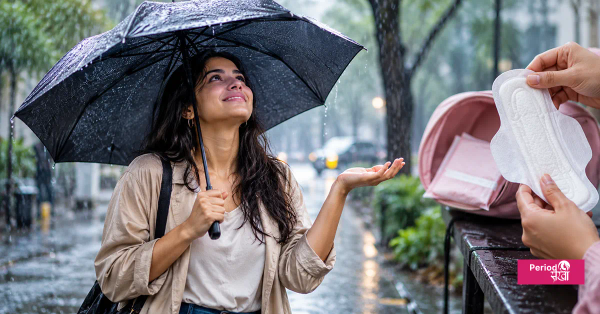

It is raining heavily. You are on your way home from college. Your jeans are getting wet. Your shoes are making that strange squishing sound with every step. Your umbrella is doing its best, but the rain is winning and then you suddenly think:
“Wait. My pad is wet too. Do I need to change it?”
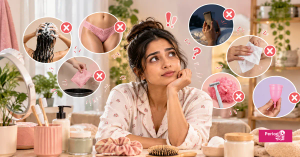
You reach the washroom, check your clothes and start wondering what to do. Should you change it immediately? Is rainwater going to cause an infection? What if the pad is only slightly damp and what if you have already been wearing it for a few hours? These are very normal questions. During the monsoon, menstrual hygiene can become a little more complicated. Wet clothes, humidity, sweating, muddy roads and fewer opportunities to find a clean washroom can make a simple pad change feel like a whole task but the basic science is actually quite simple. If your pad has become wet, soaked, heavily used or uncomfortable, change it. If only your outer clothes have become wet while the pad itself is still dry and clean, you do not have to change it simply because it has rained.
Let us understand why. First, rain does not automatically make your pad unsafe This is probably the biggest confusion. If your underwear and pad have stayed dry, there is no medical rule saying that you must change the pad simply because you were caught in the rain.
However, if rainwater has reached the pad and made it damp, or if the pad has become wet from sweat, urine, menstrual blood or any other moisture, changing it is a sensible choice. The reason is simple. A wet pad sitting against the skin is uncomfortable and can increase the chance of skin irritation. UNICEF's guide to menstrual hygiene materials notes that damp reusable menstrual materials can contribute to skin irritation and stresses the importance of proper washing and drying. So, you do not need to be scared of the rain. You just need to pay attention to what is happening to the pad.
Let's go back to that rainy afternoon.
You reach the washroom.
Your jeans are wet.
Your socks are wet.
Your hair is wet.
But you check your pad and it is completely dry.
In that situation, there is no need to panic.
You can simply dry yourself, change your wet outer clothes when possible and continue with your day.
The important thing is not “Was I in the rain?”
The important question is: “Is my menstrual product still clean, dry, secure and comfortable?”
That is a much better way to think about menstrual hygiene.
Now imagine you check and the pad is actually damp. Maybe rainwater has reached it. Maybe you have been sweating because of the humid weather. Maybe the pad has already absorbed menstrual blood and is becoming wet around the surface. In this situation, changing it is the better choice. You do not need to wait until it is completely soaked.If the pad feels wet, uncomfortable or is rubbing against your skin, you can change it. This is especially important during the monsoon because humidity can make the skin stay moist for longer.
So, how often should you actually change your pad? There is no single number that works for every person. Your flow changes. Your pad size changes. Your activity level changes and your menstrual products are different.UNICEF guidance for girls using disposable pads recommends changing them every 3–6 hours, depending on how heavy the menstrual flow is. UNICEF's technical guide also states that disposable pads should be disposed of after a maximum of 8 hours.
So a practical way to remember it is:
Change sooner when your flow is heavy, the pad is wet or full, or you feel uncomfortable. Do not keep a disposable pad on for longer than the product's recommended maximum wear time.
For many people, this means changing every few hours rather than waiting until the pad is completely saturated.
This is where many women get confused.
You may think: “There is barely any blood, so why waste another pad?”
It is understandable but the amount of blood is not the only thing to consider. If you have been wearing the pad for several hours, if it feels damp, or if the surface is causing discomfort, it is time to change. You do not need to wait for the pad to look “full”.
Then your pad may need to be changed much sooner. You might have changed it recently and still find that it is filling quickly. That is not a failure of the pad. It simply means that your flow is heavy at that point in your period.
Choose an absorbency that matches your flow and carry spare products when you are travelling and if you regularly soak through a pad very quickly, need to change pads unusually often, or your bleeding is affecting your daily life, it is worth speaking to a healthcare professional. Heavy menstrual bleeding can sometimes have an underlying cause and should not always be dismissed as something you simply have to live with.
This is where the science becomes very simple. Your vulval skin is sensitive. When the skin stays exposed to moisture, friction and warmth for a long time, it can become irritated. Think about what happens when you wear wet socks for hours. Your feet start feeling uncomfortable. The same basic idea applies to skin around the vulva. Now add menstrual blood, sweat, friction from walking and a wet pad. That is why a damp pad is not something you want sitting against your skin for a long time. The goal is not to create fear about infection. It is simply to reduce prolonged moisture and irritation.
During rainy weather, the air can feel humid even when it is not raining.
You may be sweating more.
Your clothes may take longer to dry.
You may be travelling in wet clothing.
And sometimes you may be avoiding public washrooms because they are wet, crowded or uncomfortable.
UNICEF highlights that safe menstrual hygiene is not only about having a menstrual product. People also need access to a private place to change, wash and manage menstruation safely.
This matters during the monsoon too.
Because sometimes the biggest problem is not the pad.
It is not having a clean, private and dry place to change it.
“But I cannot find a washroom right now”
This happens.
You are travelling.
You are stuck in traffic.
You are on a train.
You are returning from college.
Or you are at work and the washroom is crowded.
In these situations, planning can make things much easier.
Before leaving home during your period, keep a small pouch with:
extra pads
a clean pair of underwear
tissues or toilet paper
a small disposal bag
hand sanitiser
You may never need everything in the pouch.
But the day you do need it, you will be glad you carried it.
Change the clothes if you can. Especially your underwear. You do not have to change the pad just because your jeans got soaked but if the wet clothing is making your underwear and pad damp too, then change the pad along with the underwear. This is why checking the pad itself is useful. Do not follow a rule blindly. Check your body and your product.
If it is dry, comfortable and the menstrual flow is light, you do not necessarily need to change it simply because one hour has passed but if it has become wet from rain, sweat or urine, or if the blood has spread close to the edges, change it. The clock is useful but the condition of the pad matters too.
Menstrual health is now being discussed as much more than simply “managing blood”. WHO describes menstrual health as part of overall physical, mental and social well-being. Its current work also focuses on improving menstrual health through better information, services, products and supportive environments. UNICEF similarly emphasises four broad areas: social support, knowledge and skills, facilities and services, and access to menstrual materials. This is important because a girl should not have to choose between staying dry and reaching school. She should not have to sit through a full day because there is no private place to change and she should not feel ashamed to say, “I need to change my pad.”
For a long time, periods were treated as something that had to be hidden. Even asking for a pad could feel embarrassing But that is changing. Menstrual health education is helping girls understand not just what a period is, but how to manage it safely and confidently. UNICEF has also highlighted menstrual-health education and open conversations as important tools for helping girls ask questions, seek support and share accurate information. That is exactly the kind of conversation we need during the monsoon too.
Instead of:
“Oh no, I got wet. Is something wrong?”
We can ask:
“Is my pad wet?”
“How long have I been wearing it?”
“Is it becoming full?”
“Am I comfortable?”
Those questions are practical.
And they are much less frightening.
A common mistake is waiting until the pad is completely full before changing it. By that point, you may already be feeling uncomfortable. The blood may have reached the edges. Your underwear may be damp. You may be worrying about leakage. If your pad is becoming full, change it. You are not wasting a pad by changing it before a leak happens. You are managing your period.
Menstrual blood can develop a smell after being exposed to air for some time. That does not automatically mean you have an infection. Changing the pad regularly, washing the external genital area gently and maintaining general hygiene can help. However, if you notice a new, strong or unpleasant odour, particularly along with unusual discharge, itching, burning or pain, speak to a healthcare professional. Do not simply cover the smell with perfume or an intimate deodorant.
D — Dry: Is your pad and underwear still dry?
R — Replace: If the pad has become wet, full or uncomfortable, replace it.
Y — Your comfort matters: Do not wait for leakage or severe discomfort before changing.
It is not about being overly careful.
It is about being sensible.
So, imagine that same girl again. She is standing in the washroom after walking through the rain.
Her jeans are soaked.Her hair is dripping.She checks her pad. Surprisingly, It is dry. She smiles, changes her wet clothes when she gets home and carries on with her evening. Another day, the pad itself has become wet. This time, she changes it. No panic. No overthinking. No fear that the rain has somehow made her period dangerous. Just a simple understanding of her body. That is what good menstrual hygiene should feel like. Not scary. Not embarrassing. Just informed.
Dr. Shreya Karan is a dedicated oral and maxillofacial surgeon who brings over ten years of experience to her practice, combining surgical expertise with genuine care for her patients. She is dedicated to empowering women with accurate, evidence-based health information, helping them make informed decisions about their well-being.
About PeriodSakhi
PeriodSakhi is your trusted companion for understanding your menstrual health. With easy-to-use tools, it helps you track your periods, ovulation, fertility, moods, and symptoms, while providing insights into your overall reproductive and hormonal health. PeriodSakhi also serves as a supportive online community where women can share experiences, find reliable information, and access expert-backed guidance on menstrual health, PCOS, pregnancy, lifestyle, and more.
Disclaimer
The views, thoughts, and opinions expressed in this article/blog are solely those of the author and do not necessarily reflect the views of PeriodSakhi. Any omissions, errors, or inaccuracies are the responsibility of the author. PeriodSakhi assumes no liability or responsibility for any content presented. Always consult a qualified medical professional for specific advice related to menstrual health, fertility, pregnancy, or related conditions.