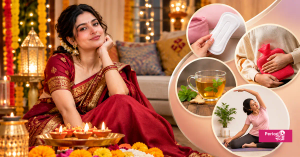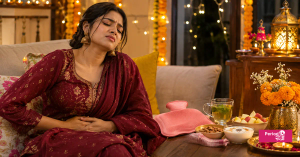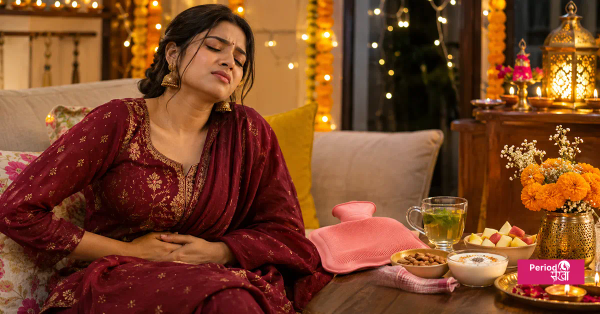

Diwali is supposed to be the happiest week of the year. It's also the week when you're standing in a kitchen at 11 pm, rolling out dough, with a heating pad you've forgotten in the bedroom and a stomach that feels twice its usual size.
If your period lands right on top of the festival, you're not alone, and you're not being dramatic. Cramps, bloating and plain exhaustion are some of the most common period complaints. Add the cleaning, the cooking and the visitors, and it's a lot for one body.
So, let's go through the three big problems one at a time, with things you can actually do.
Period pain is called dysmenorrhea. The American College of Obstetricians and Gynecologists (ACOG) explains that the uterus tightens to push out its lining, and chemicals called prostaglandins help trigger that tightening. When levels are higher, cramps tend to be stronger.
Most of the time the pain is worst in the first day or two and then fades. It can spread to your lower back and thighs, which is why you might feel it everywhere.
Here's what tends to work best.
Heat first. A hot water bottle or heating pad on your lower belly is the simplest fix. The NHS and Mayo Clinic both suggest it. If you're out, stick-on heat patches under your kurta are a decent backup. Just keep them over clothing, not directly on skin.
Move a little. You wouldn't think so, but a short walk or a few gentle stretches can loosen things up. Child's pose, where you kneel and fold forward, is a favourite for lower back pain. Five minutes is plenty.
Painkillers, carefully. Many people use over-the-counter options like ibuprofen, and they generally work better if you take them when the pain begins rather than after it's built up. But they aren't suitable for everyone, so ask a doctor or pharmacist if you have asthma, stomach trouble, kidney problems, or you take other medicines.
Warm drinks. Ginger tea, or just plain warm water, won't cure anything, but many people find it soothing. It also gives you an excuse to sit down for a few minutes.
Bloating before and during a period is common and usually comes down to hormone changes, which can make your body hold on to extra water and slow things down in your gut. Mayo Clinic lists bloating among the usual premenstrual symptoms.
The trouble is that Diwali food can make it worse. Fried snacks, heavy sweets and salty namkeen are everywhere, and it's hard to say no to every plate. You don't have to. A few small habits can help.
Spread your meals out. Eating small portions more often feels better than a few huge plates.
Sip water through the day. It sounds backwards, but drinking enough often helps with water retention.
Go slower on salt. Very salty snacks can add to that puffy feeling. Have them, but don't make them the whole meal.
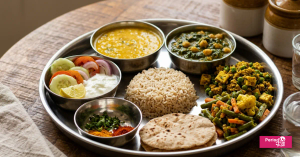
Add something light. Curd, a banana, cucumber or a bowl of dal-rice gives your stomach a break between rich dishes.
Walk after you eat. Even ten minutes helps things move along.
Try warm fennel (saunf) water or ajwain. These are traditional kitchen remedies for stomach discomfort. They're not a medical treatment, but many families swear by them.
If the bloating comes with severe pain, vomiting or something that feels very different from your usual pattern, mention it to a doctor.
And the most important thing. Wear clothes that give you room. A tight waistband on a bloated day is just misery you can avoid.
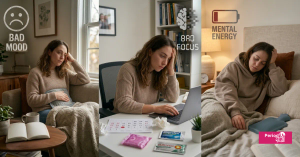
This one gets the least attention, but it hits hard. You're losing blood, your hormones are shifting, your sleep is probably off, and you're running on festival adrenaline. Of course you're tired.
A few things make a real difference.
Look at your iron. Periods cause some iron loss, and if your periods are heavy, low iron can leave you drained. The NHS lists tiredness and looking pale as common signs of iron deficiency anaemia. Eating iron-rich foods like spinach, lentils, chickpeas, jaggery, dates and dried fruit is a good habit, and adding something with vitamin C, such as lemon or an orange, helps your body absorb it. If you're exhausted all the time, not just during Diwali, get a blood test rather than guessing.
Don't skip meals. It's easy to forget to eat when you're busy hosting. Long gaps lead to energy dips, headaches and a bad mood. Keep a handful of nuts or a fruit somewhere handy.
Protect your sleep. Late-night gatherings are great, but if you can get a decent night's rest on even a few days, you'll feel the difference. A short afternoon nap helps too.
Delegate without guilt. You don't have to cook every dish or clean every corner. Hand over a few jobs. Honestly, most families would rather see you enjoying the festival than collapsing at the end of it.
Plan around your cycle. If you know roughly when your period is due, schedule big shopping trips and heavy chores before it starts, and leave the lighter tasks for your heavier days.
Be kind to your mood. Feeling low or snappy during your period is common. It's not a character flaw. If it's affecting your day-to-day life a lot, a doctor can help.
Customs about periods and festivals vary a lot between families. Some have no rules. Others have restrictions around the puja or the kitchen. How you handle it is your decision, and it's fine to find a middle path, like helping with decorations or enjoying the food and family time while skipping a ritual you're uncomfortable with. If it's causing stress, talk to someone in your family you trust, ideally at a calm moment and not in the middle of the rush.
In many Indian cities, air quality gets worse around Diwali. Firecracker smoke can trigger headaches, a heavy chest or nausea, and none of that is helpful when you already feel off. Watching the lights from a balcony, wearing a mask outside, and keeping the celebration a little lighter on crackers can save you some discomfort.
Most period symptoms are manageable at home, but don't ignore the warning signs. The NHS and Cleveland Clinic suggest getting medical advice if:
The pain is severe or doesn't ease with usual remedies
You're soaking through a pad or tampon every hour for several hours
Your periods have suddenly become much heavier or more painful
You feel faint, breathless or very weak
You have a fever along with the bleeding
Don't wait for the festival to end. A quick check-up is better than weeks of feeling bad.
You don't have to choose between taking care of yourself and enjoying Diwali. Keep a heat source close, eat regularly and lightly, drink water, look after your iron, rest when you can, and let other people carry some of the load. Do what feels right with the traditions. And if your body is telling you something is wrong, listen.
Diwali is about light and joy. You deserve to feel some of both. Happy Diwali, and look after yourself.
American College of Obstetricians and Gynecologists. Dysmenorrhea: Painful Periods. https://www.acog.org/womens-health/faqs/dysmenorrhea-painful-periods
NHS. Period pain. https://www.nhs.uk/conditions/period-pain/
Mayo Clinic. Menstrual cramps. https://www.mayoclinic.org/diseases-conditions/menstrual-cramps/symptoms-causes/syc-20374938
Mayo Clinic. Premenstrual syndrome (PMS). https://www.mayoclinic.org/diseases-conditions/premenstrual-syndrome/symptoms-causes/syc-20376780
NHS. Iron deficiency anaemia. https://www.nhs.uk/conditions/iron-deficiency-anaemia/
Cleveland Clinic. Menstrual Cramps (Dysmenorrhea). https://my.clevelandclinic.org/health/diseases/4148-menstrual-cramps
About PeriodSakhi
PeriodSakhi is your trusted companion for understanding your menstrual health. With easy-to-use tools, it helps you track your periods, ovulation, fertility, moods, and symptoms, while providing insights into your overall reproductive and hormonal health. PeriodSakhi also serves as a supportive online community where women can share experiences, find reliable information, and access expert-backed guidance on menstrual health, PCOS, pregnancy, lifestyle, and more.
Disclaimer
The views, thoughts, and opinions expressed in this article/blog are solely those of the author and do not necessarily reflect the views of PeriodSakhi. Any omissions, errors, or inaccuracies are the responsibility of the author. PeriodSakhi assumes no liability or responsibility for any content presented. Always consult a qualified medical professional for specific advice related to menstrual health, fertility, pregnancy, or related conditions.