
Imagine a classroom in an all-girls school on Children's Day. The desks have been moved aside, colourful decorations hang near the blackboard and the teacher has asked everyone to share one thing they are looking forward to as they grow older. One girl wants to become a doctor. Another dreams of travelling the world. Someone at the back says she wants to be a wildlife photographer. The room fills with laughter and excited conversations.
Then, during a short break, a quieter question comes up.
"Ma'am, what happens when a girl gets her first period?"
A few girls look at one another. Some have heard about it from their mothers or older sisters. Others have picked up bits of information from classmates. One girl knows that periods involve bleeding but is unsure where the blood comes from. Another has heard that stomach pain is inevitable. A third is worried that she might get her period while sitting in class and not know what to do.
The teacher pauses. It is Children's Day, a celebration of childhood, curiosity and the freedom to ask questions and perhaps this is one of the most important conversations the classroom can have. A first period is a significant milestone in a girl's development. Yet, many girls experience it without knowing what is happening to their bodies. Some feel frightened by the sight of blood; others feel embarrassed to ask for a sanitary pad or tell an adult. This is why conversations about menstruation should begin before menarche, not after it. Menarche is the medical term for a girl's first menstrual period. It is a normal part of puberty, but it should never be a moment of confusion, fear or shame. This Children's Day, here are five important things every parent should discuss with their daughter before her first period.
One of the first things a girl should understand is that puberty brings several changes, and menstruation is one of them. As she grows, her body begins responding to hormones that guide physical and reproductive development. She may notice that her breasts are developing, hair is growing under her arms and around her genital area, her height is increasing, or her skin is becoming oilier. Some girls also experience vaginal discharge before their first period. These changes do not happen at exactly the same age or in the same order for everyone. Most girls get their first period around the age of 12, although it can begin earlier or later. It often starts about two to three years after breast development begins. A parent does not need to explain every hormonal detail in one conversation. A simple explanation can be enough:
"Your body is growing and changing. Just as you become taller and stronger, your reproductive system is also developing. One of the changes you will experience is your period. It is a normal process, and you can always talk to me about it." It is also important to tell her that getting a period does not mean she has suddenly become an adult. She is still a child who deserves time to learn, play, study and grow at her own pace. What parents should remember: Avoid comparing her development with that of classmates, cousins or siblings. Early or later development can be a source of unnecessary anxiety when adults make casual comments about it.
For a girl who has never menstruated, seeing blood on her underwear can be frightening if nobody has explained it beforehand.
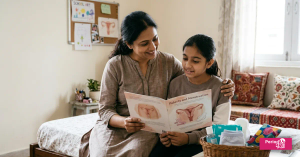
Start with the basics. Every month, hormones help prepare the uterus (womb) for a possible pregnancy. The lining of the uterus becomes thicker. When pregnancy does not occur, this lining is shed and leaves the body through the vagina as menstrual bleeding.
This is called menstruation.
You can explain it without making it sound complicated:
"Inside your body is an organ called the uterus. Its lining builds up as part of the menstrual cycle. When pregnancy does not happen, that lining comes away and leaves your body through the vagina. That is what we call a period."
A few additional facts can help her feel prepared:
Her first period may be light, sometimes appearing as just a few reddish or brownish spots.
Menstrual blood does not always look bright red. It can also appear pinkish or brown.
The first few periods may not follow a predictable schedule.
Bleeding commonly lasts between two and seven days, although individual experiences vary.
Do not describe periods as the body getting rid of dirty blood or toxins. Menstruation is not a cleansing process. It is a normal biological function. It is equally important to avoid suggesting that a girl needs to feel embarrassed about the blood. She should know that it is okay to ask for a pad, tell a teacher or speak to her mother if she notices bleeding.
Knowing what menstruation is helps, but knowing what to do when it actually begins is equally important.
A first period may start at home, during a school lesson, while travelling or when she is playing with friends. It may not arrive on a date she expects. Preparing her for these ordinary situations can make a considerable difference.
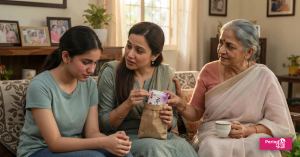
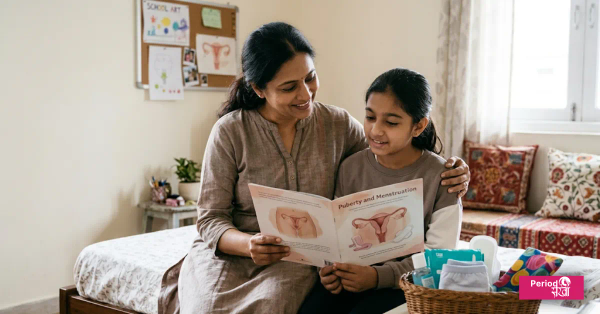
Start by showing her how to use a sanitary pad. Explain how to remove the backing, place the adhesive side on her underwear and change the pad when needed. Let her know that she can ask for help if she is unsure.
She should also understand a few basic hygiene practices:
Wash her hands before and after changing a menstrual product.
Change sanitary pads every few hours, or sooner if they become soaked.
Wrap used disposable pads before placing them in a bin.
Wash the external genital area gently with water.
Avoid scented intimate washes and vaginal douching.
Wear clean, comfortable underwear.
Some girls hear that they should avoid sports, swimming, dancing, school activities or certain foods once they begin menstruating. Others are told to stay away from friends or restrict their usual routines. These messages can make a normal biological process feel like a limitation.
Explain that menstruation does not mean she has to stop being a child. She can attend school, play, participate in competitions, exercise and spend time with friends. If she feels comfortable, she can continue her usual activities. She may experience cramps, tiredness, breast tenderness, headaches or mood changes around her period. Not everyone experiences these symptoms, and their intensity can vary from one cycle to another.
For mild discomfort, a warm compress, gentle movement, adequate sleep and regular meals may help. If pain is severe or repeatedly interferes with school and daily activities, it should not simply be dismissed as something every girl has to tolerate. Also discuss food without creating unnecessary restrictions. She does not need to avoid curd, sour foods, cold drinks or particular fruits because she is menstruating. A balanced diet, enough fluids and iron-rich foods support general health. Most importantly, tell her that she can speak up when she is uncomfortable. She does not need to hide pain to appear strong.
Perhaps the most valuable thing a parent can tell a daughter is that no question about her body is embarrassing. Girls may hear different explanations from friends, social media, older relatives and schoolmates. Some information may be accurate; some may be incomplete or incorrect. She may wonder whether periods are supposed to hurt, whether everyone gets them at the same age, whether she can bathe or whether anyone will know when she is menstruating. Rather than waiting for her to ask, create opportunities for conversation. Ask what she has learnt at school and whether she has heard anything that confused her. Listen without laughing, scolding or making her feel childish.
Some important messages to share include:
Menstruation is natural and does not make a girl dirty or impure.
She does not need to hide sanitary products or feel ashamed of buying them.
Periods can be different for different people.
She can ask a trusted adult for help at home or at school.
Nobody should tease, threaten or make her uncomfortable because she menstruates.
She can ask the same question more than once if she has not understood the answer.
It is also worth explaining that privacy is different from shame. She may prefer not to discuss her period with classmates, and that choice should be respected. But she should never feel that she has to conceal it from every adult, especially when she needs help. UNICEF recommends making period conversations ongoing and age-appropriate rather than treating them as a single, formal discussion. It also encourages families to involve schools and other trusted adults in supporting girls.
Parents play an important role, but a girl may spend much of her day at school. That means her school should also be a place where she can seek help without embarrassment.
In an all-girls classroom, a Children's Day discussion about growing up can include puberty and menstruation in a simple, age-appropriate way. Teachers do not need to turn it into a complicated biology lecture. They can explain what a period is, demonstrate how to use a sanitary pad and tell students whom to approach if they need help.
Schools can make a practical difference by ensuring that:
Clean, lockable toilets with water are available.
Sanitary pads can be accessed discreetly.
Covered bins are provided for disposing of used products.
Teachers know how to respond calmly when a student gets her first period.
Girls are not teased or made to feel uncomfortable because of menstrual stains or symptoms.
A UNICEF report from Giridih, Jharkhand, describes how a school-based menstrual health initiative helped a student who was confused and unprepared when she experienced menarche. It is a reminder that a supportive teacher and access to a sanitary pad can make a real difference at a vulnerable moment. Menstrual education should not be treated as a one-day activity around a health awareness event. Girls need accurate information before their first period and continued support as they learn to manage their cycles.
Menstruation varies from one girl to another, and the first few years can involve irregular cycles while the body adjusts to hormonal changes. However, some signs deserve medical attention.
Consider speaking to a paediatrician or gynaecologist if:
Puberty-related changes begin before the age of eight.
A girl has not had her first period by age 15.
Her first period has not started within about three years of breast development.
Bleeding is very heavy, lasts longer than seven days or causes significant weakness.
Period pain is severe enough to interfere with school or everyday activities.
A doctor can assess whether the timing and symptoms are within the expected range and whether any further evaluation is needed.
1. What is menarche?
Menarche is the medical term for a girl's first menstrual period. It is one of the milestones of puberty and indicates that the reproductive system is developing.
2. At what age do girls usually get their first period?
Many girls get their first period around age 12, although it can begin earlier or later. The timing varies between individuals and is influenced by several factors, including genetics and overall development.
3. What are the signs that a girl's first period may be approaching?
Breast development, growth of pubic and underarm hair, a growth spurt and vaginal discharge can occur during puberty. The first period often begins around two to three years after breast development starts, but there is no exact timetable.
4. What should a girl carry in her school bag before her first period?
A small pouch with a few sanitary pads, spare underwear, tissues and a disposal bag can be useful. She should also know which trusted teacher or school staff member can help if her period begins unexpectedly.
5. Are irregular periods normal after menarche?
Yes. Menstrual cycles may be irregular during the first few years after the first period as the body adjusts to hormonal changes. However, very heavy bleeding, prolonged bleeding or severe pain should be discussed with a healthcare professional.
6. Should girls avoid sports or physical activity during periods?
No. Girls can generally continue sports, exercise and other daily activities during menstruation. They can adjust their activity if they experience discomfort or fatigue.
7. How can parents make the first-period conversation less awkward?
Begin with simple, everyday conversations about puberty and body changes. Ask what your daughter already knows, use correct words, answer honestly and reassure her that she can return with more questions whenever she needs to.
Children's Day is a reminder that children deserve more than celebrations, gifts and a day away from routine. They deserve the information and support that help them understand themselves as they grow. A girl should not have to learn about menstruation through a frightening surprise in a school washroom. She should know what is happening, where to find a sanitary pad, whom to approach and why there is nothing to be ashamed of. Parents do not need to have one perfect conversation. They need to keep the door open. A few honest discussions, a prepared school pouch and a reassuring response can make the transition into menstruation much easier. At PeriodSakhi, we believe menstrual awareness begins long before the first period. When girls are given accurate information early, they are better equipped to understand their bodies, care for themselves and ask for help without hesitation. This Children's Day, let us give every daughter something that lasts beyond the celebration: the confidence to grow up informed, comfortable and unafraid of her own body.
About PeriodSakhi
PeriodSakhi is your trusted companion for understanding your menstrual health. With easy-to-use tools, it helps you track your periods, ovulation, fertility, moods, and symptoms, while providing insights into your overall reproductive and hormonal health. PeriodSakhi also serves as a supportive online community where women can share experiences, find reliable information, and access expert-backed guidance on menstrual health, PCOS, pregnancy, lifestyle, and more.
Disclaimer
The views, thoughts, and opinions expressed in this article/blog are solely those of the author and do not necessarily reflect the views of PeriodSakhi. Any omissions, errors, or inaccuracies are the responsibility of the author. PeriodSakhi assumes no liability or responsibility for any content presented. Always consult a qualified medical professional for specific advice related to menstrual health, fertility, pregnancy, or related conditions.