
You have finally planned the trip.
The tickets are booked.
The hotel is confirmed.
The outfits are ready.
Your playlist is downloaded.
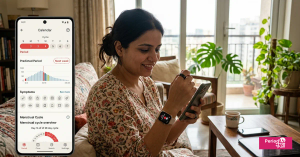
And then you check your period tracker.
“Oh. My period is coming that week.”
Your period does not know that you have booked a flight to Goa.
It does not care that you have planned a trek and, unfortunately, it does not move itself because you have a honeymoon, beach holiday or three-day wedding.
If you already track your cycle, check your expected period before travelling.
You do not need to know the exact day.
Periods can naturally vary from cycle to cycle, so think of the prediction as a guide rather than a guarantee.
If your period is expected during your trip, prepare accordingly.
And if your cycle is irregular, it becomes even more useful to carry products with you instead of assuming your period will arrive on a particular day.
Because the most inconvenient period is usually the one that begins when you have absolutely nothing with you.
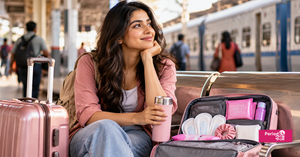
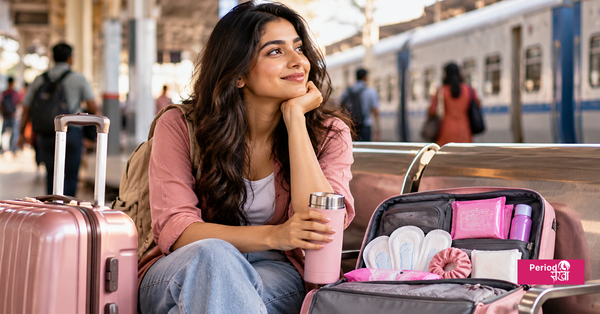
Your travel period kit does not have to be complicated.
Carry enough of your usual menstrual product for the journey, plus some extra.
That might mean:
disposable pads
tampons
a menstrual cup or disc
reusable pads
period underwear
spare underwear
tissues or toilet paper
a small disposal bag
hand sanitiser
The best product is not the one that looks most modern.
It is the one you know how to use comfortably and safely.
UNICEF recognises several menstrual products, including disposable and reusable pads, tampons, cloths, cups, discs and period underwear. The choice depends on personal preference, availability and the setting.
This is one of those lessons that sounds obvious until someone learns it the hard way.
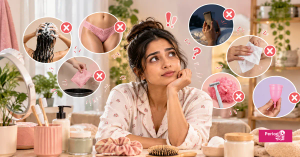
If you have never used a menstrual cup before, your holiday is probably not the best time for your first experiment.
The same applies to a new tampon, unfamiliar pad or new period underwear.
Travel already gives you enough surprises.
You do not need to add:
“Why does this product feel like this?”
A three-hour journey can feel very different when you are on your period. You may not always have immediate access to a clean toilet. You may be sitting for long periods. You may have cramps. You may also be worried about leakage. So, keep your period products inside your hand luggage or personal bag, not buried at the bottom of a large suitcase. If you are flying, do not put your entire period supply into checked baggage.
Imagine landing after a long flight and discovering that your suitcase has decided to take a separate holiday. Not ideal. Keep the essentials with you.
There is no single changing schedule that works for every menstrual product.
It depends on the product and your flow.
For disposable pads, UNICEF guidance commonly suggests changing them every 3–6 hours depending on menstrual flow.
Tampons need regular changing too; UNICEF recommends changing them every 4–8 hours.
If your product feels full, wet, uncomfortable or is leaking, change it sooner.
Travelling does not mean you should wait until you reach your hotel.
If there is a clean toilet available, use it.
Your period does not have to follow your sightseeing schedule.
This is one of the less glamorous realities of travel.
You may be on a highway.
You may be at a crowded railway station.
You may be hiking.
You may be travelling somewhere where toilets are limited.
This is exactly why carrying a small emergency kit helps. Keep a few extra products, tissues and disposal bags somewhere easy to reach. If you are using a reusable product, plan where you will be able to clean it properly. UNICEF guidance on menstrual materials considers access to water, sanitation, privacy, cleaning and disposal when assessing whether products can be used safely in different settings. The beautiful mountain view can wait five minutes. Your hygiene should not have to.
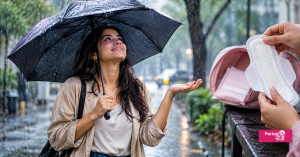
Used disposable pads should not be flushed down toilets. Wrap them properly and place them in an appropriate bin. UNICEF specifically advises disposing of used menstrual products in a bin rather than flushing them. This becomes especially important while travelling because toilets may have different plumbing systems and waste-management facilities. So, carry a few small disposal bags. They take almost no space and they can be extremely useful when there is no suitable bin inside the toilet.
World Health Organization. Menstrual health and hygiene.
UNICEF. Guidance for Monitoring Menstrual Health and Hygiene.
UNICEF. How to talk to your daughter about periods.
UNICEF. Guide to Menstrual Hygiene Materials.
WHO. International Travel and Health: Environmental Health Risks.
WHO. Improving health: Menstrual hygiene management.
About PeriodSakhi
PeriodSakhi is your trusted companion for understanding your menstrual health. With easy-to-use tools, it helps you track your periods, ovulation, fertility, moods, and symptoms, while providing insights into your overall reproductive and hormonal health. PeriodSakhi also serves as a supportive online community where women can share experiences, find reliable information, and access expert-backed guidance on menstrual health, PCOS, pregnancy, lifestyle, and more.
Disclaimer
The views, thoughts, and opinions expressed in this article/blog are solely those of the author and do not necessarily reflect the views of PeriodSakhi. Any omissions, errors, or inaccuracies are the responsibility of the author. PeriodSakhi assumes no liability or responsibility for any content presented. Always consult a qualified medical professional for specific advice related to menstrual health, fertility, pregnancy, or related conditions.