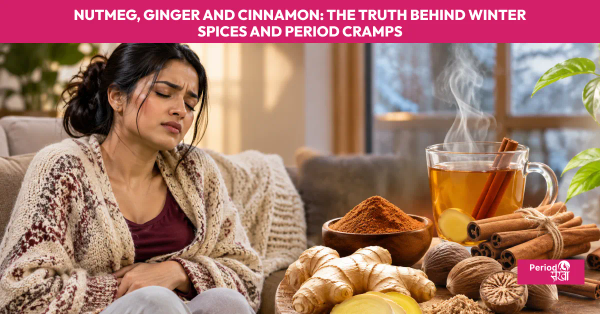

“A little warmth in your winter kitchen may bring comfort to your day, but does it really make those difficult period days easier?”
It is that time of the year when the kitchen begins to smell of ginger tea, freshly prepared halwa and cinnamon-spiced milk. Winter has a way of bringing certain ingredients back into our everyday meals. Among them, nutmeg, ginger and cinnamon hold a special place in Indian households. These spices are not just about flavour. They have been used in traditional food practices for generations, particularly during colder months. Some are associated with digestive comfort, while others are believed to help with body aches, inflammation and menstrual discomfort.
One afternoon, Diksha and Vamika find themselves discussing their winter food habits over a cup of tea.“I have been adding a little cinnamon to my morning tea. My mother says it is good for period cramps,” Diksha says. Vamika laughs. “My grandmother has a different suggestion. She adds nutmeg to warm milk and insists that it helps with sleep and period discomfort. And ginger? Apparently, it can solve almost every winter problem!”
“But is there any actual science behind these claims?” Diksha asks. “Or are we simply following everything our grandmothers tell us?” That is where things get interesting. Ginger, cinnamon and nutmeg contain naturally occurring compounds that have been studied for their anti-inflammatory, antioxidant and other biological properties. However, their potential benefits are not identical, and the scientific evidence supporting their use for menstrual cramps varies considerably.
Let's separate traditional wisdom from medical evidence.
Before discussing the spices, it helps to understand why periods can be painful. Menstrual cramps, medically known as dysmenorrhoea, are commonly experienced during the first few days of menstruation. They occur when the uterus contracts to shed its inner lining. These contractions are influenced by substances called prostaglandins. They are lipid-derived chemical messengers involved in inflammation, pain and muscle contraction. Higher levels of certain prostaglandins, particularly prostaglandin F2 alpha (PGF2α), are associated with stronger uterine contractions and increased menstrual pain.
This is why some commonly prescribed pain-relieving medicines, particularly non-steroidal anti-inflammatory drugs (NSAIDs), work by reducing prostaglandin production. Certain compounds found in spices have also attracted scientific interest because of their potential effects on inflammatory pathways. However, laboratory findings do not automatically translate into proven clinical benefits. The quantity consumed in ordinary cooking, the concentration of active compounds and the way a spice is prepared all matter.
If there is one winter spice that has attracted considerable research attention for menstrual discomfort, it is ginger. Known scientifically as Zingiber officinale, ginger contains bioactive compounds called gingerols and shogaols. These compounds have demonstrated anti-inflammatory and antioxidant properties in experimental research.
But can ginger actually help with period cramps?
There is some encouraging clinical evidence. A 2024 systematic review and meta-analysis published in the Journal of Integrative and Complementary Medicine examined 24 studies qualitatively and included 12 studies in its quantitative analysis. The researchers reported that ginger supplementation was associated with reductions in both menstrual pain intensity and pain duration compared with placebo.
Interestingly, the analysis also found no significant difference between ginger and NSAIDs in pain intensity. However, the researchers highlighted important limitations, including variations in study quality and insufficient safety reporting. Another systematic review published in 2020 examined nine clinical studies involving 647 participants and reported potential benefits of ginger, cinnamon and fennel for primary dysmenorrhoea.
What does this mean for everyday consumption?
It suggests that ginger deserves further research as a possible supportive approach to menstrual pain management. However, the evidence primarily concerns specific supplement preparations and doses, not ordinary ginger tea.
Diksha: “So, does drinking ginger tea during my period mean I can expect fewer cramps?”
Vamika: “Not necessarily. It may be a comforting drink, and ginger has some promising research behind it. But a cup of tea is not the same as a clinically studied ginger supplement.”
Ginger can be added to everyday meals, soups and beverages. Women taking blood-thinning medicines or considering concentrated ginger supplements should discuss their use with a healthcare professional.
Cinnamon is another winter favourite, particularly in tea, porridge, baked foods and traditional Indian preparations.
It contains naturally occurring compounds, including cinnamaldehyde, which have been investigated for their antioxidant and anti-inflammatory properties.
Some clinical research has also examined cinnamon specifically for menstrual discomfort.
A systematic review and meta-analysis published in 2020 evaluated herbal interventions, including cinnamon and ginger, for primary dysmenorrhoea. Its findings suggested that cinnamon may reduce pain intensity and potentially shorten pain duration.
However, the available trials were relatively limited. The findings should not be interpreted as proof that cinnamon can consistently treat menstrual cramps.
Cinnamon is also being studied for its possible influence on glucose metabolism. However, this does not mean that adding cinnamon to tea will regulate menstrual hormones or correct conditions such as polycystic ovary syndrome (PCOS).
There is an important difference between studying a spice's biological activity and establishing it as a treatment for a medical condition.
Diksha: “I have heard that cinnamon balances hormones. Is that true?”
Vamika: “That is a little too broad. Cinnamon has been studied for several metabolic effects, but we cannot say that ordinary dietary consumption balances hormones or regulates everyone's menstrual cycle.”
One additional consideration is the type of cinnamon.
Cassia cinnamon, which is commonly available, contains more coumarin than Ceylon cinnamon. Regular consumption of large quantities of coumarin-rich cinnamon may pose a risk to liver health.
Using small culinary quantities is different from taking concentrated cinnamon supplements.
Nutmeg, known as Myristica fragrans, is often associated with winter desserts, warm milk and traditional household remedies.
Its distinctive aroma comes from naturally occurring compounds, including myristicin and other aromatic constituents. Nutmeg has been investigated for various biological properties, including antioxidant and anti-inflammatory activity. However, evidence directly establishing its effectiveness for menstrual cramps in humans is lacking.
In other words, nutmeg may be a pleasant addition to winter meals, but it cannot currently be recommended as a scientifically established treatment for period pain.
There is also an important safety consideration. Nutmeg is not a spice to consume in large quantities in an attempt to obtain medicinal benefits. Excessive intake can cause toxicity, with symptoms such as nausea, vomiting, dizziness, agitation, confusion and, in severe cases, hallucinations and other serious effects. A small culinary pinch used for flavouring is very different from consuming concentrated amounts.
Diksha: “So my grandmother's nutmeg milk can stay, but I should not start adding extra spoonfuls?”
Vamika: “Exactly! Enjoy the flavour, not the idea that more must mean better.”
Spice | What research suggests | What remains uncertain |
|---|---|---|
Ginger | Clinical studies suggest potential reduction in menstrual pain intensity | Ideal dose, long-term safety and effectiveness of ordinary tea |
Cinnamon | Some studies suggest possible reduction in menstrual pain | Consistency of results and long-term effectiveness |
Nutmeg | Experimental research suggests antioxidant and anti-inflammatory properties | Direct clinical evidence for menstrual pain relief |
The important takeaway is that ginger currently has more encouraging clinical evidence among these three spices. Cinnamon has some preliminary clinical support, while nutmeg lacks convincing human evidence for treating period cramps.
None should replace established medical treatment.
If there is one thing Diksha and Vamika agree on, it is that winter food should be enjoyable. There is no need to turn every meal into a medicinal preparation.
Here are three simple recipes that incorporate these spices in ordinary culinary quantities.
A comforting drink for cold mornings and evenings.
Ingredients:
1 cup water
½–1 inch freshly crushed ginger
½ teaspoon lemon juice
A little honey, if desired
Preparation:
Bring water to a gentle boil.
Add crushed ginger and allow it to simmer for approximately 5–7 minutes.
Strain into a cup.
Allow it to cool slightly before adding lemon juice.
Add a little honey if preferred.
Why include it?
Ginger contains gingerols and other bioactive compounds that have been studied for their anti-inflammatory properties. Lemon contributes vitamin C, while the warm beverage helps maintain fluid intake.
It is a comforting winter drink, although it should not be considered a proven treatment for menstrual cramps.
A nourishing breakfast for days when you want something warm and filling.
Ingredients:
½ cup rolled oats
1 cup milk or an unsweetened plant-based alternative
½ apple, chopped
A small pinch of cinnamon
A very small pinch of nutmeg
1 teaspoon chopped almonds or walnuts
Preparation:
Add oats and milk to a saucepan.
Cook over a low flame until the oats become soft and creamy.
Add chopped apple and cinnamon.
Add a tiny pinch of nutmeg for flavour.
Finish with chopped nuts and serve warm.
Why include it?
Oats provide dietary fibre and complex carbohydrates. Apples contribute fibre, while nuts provide healthy fats and additional nutrients. Cinnamon and nutmeg add flavour without requiring excessive sugar. The combination makes a balanced breakfast option, particularly when appetite and food cravings change around menstruation.
A warm, fibre-rich dinner option for winter evenings.
Ingredients:
1 cup chopped carrots
¼ cup washed red lentils (masoor dal)
½ inch grated ginger
¼ teaspoon cumin seeds
2 cups water or low-sodium vegetable stock
1 teaspoon cooking oil
Salt and black pepper to taste
Preparation:
Heat oil in a saucepan and add cumin seeds.
Add grated ginger and chopped carrots.
Add washed lentils and water.
Simmer until the carrots and lentils are completely cooked.
Blend until smooth or leave slightly chunky.
Add salt and black pepper before serving.
Why include it?
Carrots provide beta-carotene, while lentils contribute plant-based protein, iron and fibre. Ginger adds flavour and contains compounds being investigated for their anti-inflammatory properties. Adding lemon juice before serving can also improve the absorption of non-haem iron from lentils. These recipes are intended as nutritious food ideas, not therapeutic formulations. Their benefits come from the overall nutritional composition rather than any guaranteed effect of the spices.
This is where moderation becomes important.
Spices are generally safe when used in the small quantities normally required for cooking. However, concentrated extracts, powders and supplements may expose the body to much higher amounts of active compounds.
A few practical considerations are worth remembering:
Ginger: Culinary quantities are generally well tolerated, although larger amounts may cause heartburn or gastrointestinal discomfort in some people. Discuss concentrated supplements with a healthcare professional if you take blood-thinning medication.
Cinnamon: Small amounts used in food are generally acceptable. Avoid regularly consuming large quantities of Cassia cinnamon because of its coumarin content.
Nutmeg: Use only a small culinary pinch. Never consume large amounts for medicinal purposes because nutmeg toxicity can be serious.
Women who are pregnant, breastfeeding, taking regular medication or managing an existing health condition should seek professional advice before using concentrated herbal preparations.
There is a tendency to normalise menstrual pain, particularly when women have experienced it since adolescence. Severe cramps should not automatically be accepted as an unavoidable part of menstruation. Primary dysmenorrhoea occurs without an identifiable underlying pelvic condition. Secondary dysmenorrhoea, on the other hand, may be associated with conditions such as endometriosis, adenomyosis or uterine fibroids.
Medical evaluation is important when period pain:
Interferes with work, studies or everyday activities.
Becomes progressively worse over time.
Does not improve with usual pain-relief measures.
Occurs alongside very heavy bleeding.
Is accompanied by pelvic pain between periods or pain during intercourse.
NSAIDs are commonly recommended for primary dysmenorrhoea because they reduce prostaglandin production. Heat therapy and appropriate physical activity may also help manage symptoms. A diet rich in essential nutrients can complement these measures, but spices should never delay an appropriate gynaecological assessment.
By the time their tea is finished, Diksha has already decided to try Vamika's ginger and carrot soup recipe.
“I think I will keep the cinnamon in my oats and ginger in my tea. But I am definitely not experimenting with extra nutmeg,” she says.
Vamika laughs. “That sounds like a much better winter plan!”
Traditional food practices often have a place in everyday wellness, and modern research is beginning to explore the biological properties of ingredients that have been used for generations. Ginger has shown promising results in clinical research on primary dysmenorrhoea, while cinnamon has some preliminary evidence. Nutmeg, despite its traditional popularity, has not been established as a treatment for menstrual pain.
The real value of these spices lies in enjoying them as part of a varied, balanced diet while understanding their limitations. Winter can be a good time to rediscover familiar ingredients, experiment with nutritious recipes and pay closer attention to menstrual health. After all, the goal is not to find a magical ingredient that makes periods disappear from the list of monthly discomforts. It is to make informed choices that support women's health throughout the year.
Moshfeghinia R, et al. Ginger for Pain Management in Primary Dysmenorrhea: A Systematic Review and Meta-Analysis. Journal of Integrative and Complementary Medicine. 2024;30(11):1016–1030. https://doi.org/10.1089/jicm.2023.0799.
Xu Y, Yang Q, Wang X. Efficacy of herbal medicine (cinnamon/fennel/ginger) for primary dysmenorrhea: A systematic review and meta-analysis of randomized controlled trials. Journal of International Medical Research. 2020;48(6). https://doi.org/10.1177/0300060520936179.
Daily JW, Zhang X, Kim DS, Park S. Efficacy of Ginger for Alleviating the Symptoms of Primary Dysmenorrhea: A Systematic Review and Meta-analysis of Randomized Clinical Trials. Pain Medicine. 2015;16(12):2243–2255. https://doi.org/10.1111/pme.12853.
Pattanittum P, et al. Dietary supplements for dysmenorrhoea. Cochrane Database of Systematic Reviews. 2016;(3):CD002124. https://doi.org/10.1002/14651858.CD002124.pub2.
National Center for Complementary and Integrative Health (NCCIH). Ginger: Usefulness and Safety. https://www.nccih.nih.gov/health/ginger.
National Health Service (NHS). Period pain. https://www.nhs.uk/symptoms/period-pain/.
About PeriodSakhi
PeriodSakhi is your trusted companion for understanding your menstrual health. With easy-to-use tools, it helps you track your periods, ovulation, fertility, moods, and symptoms, while providing insights into your overall reproductive and hormonal health. PeriodSakhi also serves as a supportive online community where women can share experiences, find reliable information, and access expert-backed guidance on menstrual health, PCOS, pregnancy, lifestyle, and more.
Disclaimer
The views, thoughts, and opinions expressed in this article/blog are solely those of the author and do not necessarily reflect the views of PeriodSakhi. Any omissions, errors, or inaccuracies are the responsibility of the author. PeriodSakhi assumes no liability or responsibility for any content presented. Always consult a qualified medical professional for specific advice related to menstrual health, fertility, pregnancy, or related conditions.