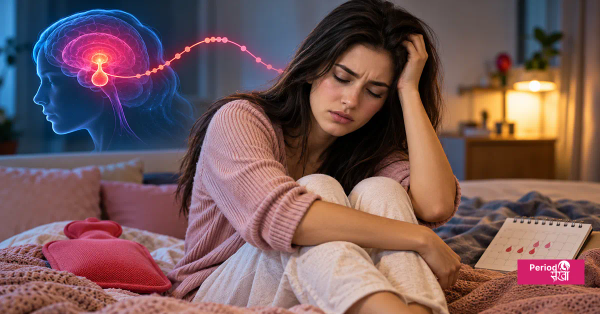

Akriti was sitting on her bed, staring at her phone. She had a presentation to finish, messages to reply to and a long list of things to do. Even a small question from her family felt irritating.
Sukriti noticed that something was wrong.
Sukriti: “You seem stressed today. Is everything okay?”
Akriti: “I don't know! I have so much work, my stomach hurts, and I feel like crying. My period is due soon. Can hormones really make everything feel worse?”
Sukriti: “Maybe. I read about a hormone called cortisol. It is linked to stress, but I don't know how it works during periods.”
Their conversation raises a useful question. Could the stress you feel before or during menstruation be connected to cortisol? And why do some days feel harder than others?
Let's explore the science together.
Akriti: “First, what is cortisol? Is it really the stress hormone everyone talks about?”
Sukriti: “Yes, that's its popular name. But cortisol does much more than respond to stress.”
Cortisol is a hormone produced by the adrenal glands, which sit above the kidneys. It helps the body respond to challenges and supports several important functions, including:
Managing how the body uses energy.
Helping regulate blood pressure.
Influencing inflammation and immune activity.
Supporting the body's response to physical and emotional stress.
Cortisol is a hormone your adrenal glandsmake and release. It’s a glucocorticoid, a type of steroid hormone. You may mainly think of cortisol when it comes to stress. But it’s an essential hormone that affects almost every organ and tissue in your body. It plays many other important roles, including:
Regulating how your body uses glucose (sugar) for energy
Decreasing inflammation
Regulating blood pressure
Helping control your sleep-wake cycle
Your body continuously monitors your cortisol levels to maintain steady levels (homeostasis). High or low cortisol levels can be harmful to your health.
Yes, cortisol plays a key role in managing your body’s stress response. Your body releases cortisol when you experience any of the following types of stress:
Acute (short-term) stress
Chronic (long-term) stress
But cortisol has many other functions, too.
When you face a stressful situation, your brain communicates with the adrenal glands through a system called the hypothalamic-pituitary-adrenal (HPA) axis.
Here is how it works in simple terms:
The hypothalamus, a part of the brain, detects signals related to stress and releases corticotropin-releasing hormone (CRH).
The pituitary gland receives this signal and releases adrenocorticotropic hormone (ACTH).
ACTH signals the adrenal glands to release cortisol.
Cortisol helps your body respond to the situation. Once the challenge passes, feedback signals help the system settle down.
Akriti: “So cortisol isn't bad?”
Sukriti: “Not at all. We need it. The problem isn't having cortisol; it's how the body regulates its response over time.”
Another interesting fact is that cortisol follows a daily rhythm. It generally rises around waking and falls towards the evening, although the exact pattern varies between people. Stress, sleep, illness and daily routines can affect this rhythm.
Akriti: “But why are we talking about cortisol during periods? Isn't menstruation controlled by reproductive hormones?”
Sukriti: “It is, but the brain, stress system and reproductive system communicate with one another.”
The menstrual cycle is regulated by hormones, including oestrogen and progesterone. These hormones help control the development of an egg, ovulation and changes in the lining of the uterus.
They can also interact with the body's stress-response system. This means the menstrual cycle and cortisol regulation may influence one another.
However, there is an important distinction: cortisol does not automatically rise every time you get your period.
A systematic review and meta-analysis published in 2022 examined 121 studies involving 2,641 participants. It found small differences in average cortisol concentrations across some menstrual-cycle phases. Cortisol was slightly higher in the follicular phase than in the luteal phase, and one comparison found higher levels during menstruation than in the premenstrual phase.
These differences were small, and the studies did not all use the same methods. Researchers are still working to understand how menstrual hormones influence cortisol.
In other words, there is no single cortisol pattern that applies to every woman.
Akriti: “That makes sense. But why do I sometimes feel like I have less patience just before my period?”
Sukriti: “It could be a combination of things, not just one hormone.”
Several factors may contribute to how you feel around menstruation.
Oestrogen and progesterone change throughout the menstrual cycle. They can affect systems in the brain that help regulate mood and the body's response to stress.
Research suggests that the cortisol response to a stressful event may differ across menstrual-cycle phases. A 2023 systematic review found evidence of a small increase in cortisol reactivity during the luteal phase compared with the follicular phase.
But the evidence came from a limited number of studies, so more research is needed. This does not mean that every woman becomes more stressed before her period.
Akriti: “When I have cramps, even normal work feels exhausting.”
Sukriti: “Exactly. Pain itself can be stressful.”
Menstrual cramps happen when the uterus contracts to help shed its lining. Chemicals called prostaglandins play an important role in these contractions.
If you are dealing with cramps, headaches, back pain or bloating, you may have less energy for other demands. Poor sleep caused by discomfort can make it even harder to concentrate or manage emotions.
This does not prove your cortisol is high. It shows how physical symptoms and emotional stress can affect each other.
A late night, repeated waking or an irregular sleep schedule can affect mood, attention and the body's stress regulation.
If your period disrupts your sleep, you may feel less patient the next day. A task that normally seems manageable can suddenly feel overwhelming.
Work deadlines, financial worries, relationship problems and family responsibilities do not disappear when your period begins.
When these pressures overlap with fatigue or menstrual discomfort, they may feel harder to manage. The menstrual cycle may be one part of the picture, rather than the whole explanation.
Akriti: “Can the situation work the other way around? Can stress affect my cycle too?”
Sukriti: “Yes, especially when stress is intense or continues for a long time.”
The brain's stress-response system can interact with the system that controls reproductive hormones. Under significant or prolonged stress, changes in the release of reproductive signals may interfere with ovulation.
This can sometimes lead to irregular periods or missed periods. Other factors, including substantial weight changes, inadequate food intake, excessive exercise, illness, thyroid problems and pregnancy, can also affect the menstrual cycle.
One stressful day is unlikely to stop your period by itself. If your periods become repeatedly irregular or stop unexpectedly, do not assume stress is the only reason. Speak with a healthcare professional to check for other possible causes.
Akriti: “I can't remove all the stress from my life. What can I actually do?”
Sukriti: “You don't need to change everything at once. Start with a few things that feel realistic.”
Here are some simple habits that may support your general well-being:
Protect your sleep. Try to go to bed and wake up at similar times each day. A regular routine can support sleep quality and help regulate the body's daily rhythms.
Eat regular, balanced meals. Include sources of protein, fibre-rich carbohydrates, vegetables, fruit and healthy fats. Avoid skipping meals if it leaves you feeling weak or irritable.
Move in a way that feels comfortable. Walking, stretching, yoga or other gentle activities may help you manage stress. Adjust the intensity if cramps or fatigue make exercise uncomfortable.
Make space for short breaks. A few minutes of slow breathing, a quiet walk or time away from your phone may help you feel more settled.
Track your symptoms. Record your period dates, sleep, stress levels, pain and mood for two or three cycles. Patterns can help you understand what happens before and during menstruation.
Ask for support. Talking to a friend, family member or healthcare professional can help when you feel overwhelmed. You do not need to manage everything alone.
These steps can support well-being, but they do not guarantee a specific change in cortisol levels.
Not always. Research has found small differences in cortisol levels across some menstrual-cycle phases, but findings vary. Cortisol is also affected by sleep, the time of day, illness, medication and stress. You cannot tell whether your cortisol is high simply by how you feel.
There is no simple, established rule that high cortisol directly causes menstrual cramps. Period pain is strongly linked to uterine contractions and prostaglandins. Stress may influence how pain feels and how well you cope with it, but severe or worsening pain deserves medical assessment.
Significant or prolonged stress can interfere with the brain signals involved in ovulation and may contribute to irregular or missed periods. However, pregnancy and other health conditions can also cause changes in your cycle. Seek medical advice if your period is unexpectedly absent or irregular.
Symptoms such as tiredness, irritability or poor sleep cannot confirm high cortisol because they have many possible causes. Cortisol testing is used in specific medical situations and must be interpreted by a healthcare professional. A single test is not a reliable general measure of how stressed you feel.
Speak with a healthcare professional if stress or mood changes regularly interfere with daily life, your periods become persistently irregular, or you experience severe menstrual pain or heavy bleeding. If you feel persistently anxious or low, support is available. You do not need to wait until symptoms become unbearable.
By the end of their conversation, Akriti had a better understanding of what might be happening.
Akriti: “So my period doesn't automatically mean my cortisol is high?”
Sukriti: “Right. Your body is more complicated than that. Hormones, sleep, pain and everyday stress can all play a role.”
Cortisol is an essential hormone that helps the body respond to challenges. Its relationship with the menstrual cycle is real, but it is also complex. Research has found differences in cortisol patterns and stress responses across some phases of the cycle, yet there is no universal pattern that explains how every woman feels.
If you notice that certain days of your cycle feel more difficult, try tracking your symptoms and paying attention to your sleep, meals, stress and physical comfort. Small changes may help, and medical advice is important when symptoms affect your daily life.
At PeriodSakhi, conversations about women's health go beyond periods and cramps. Understanding the links between reproductive hormones, stress and emotional well-being can help women make sense of their experiences without blaming themselves for how they feel.
Your body is not working against you. Learning to understand it is a step towards taking better care of yourself.
Klusmann, H. et al. (2022). HPA axis activity across the menstrual cycle: A systematic review and meta-analysis of longitudinal studies. Frontiers in Neuroendocrinology. https://pubmed.ncbi.nlm.nih.gov/35597328/
Klusmann, H. et al. (2023). Menstrual cycle-related changes in HPA axis reactivity to acute psychosocial and physiological stressors: A systematic review and meta-analysis. Neuroscience & Biobehavioral Reviews. https://pubmed.ncbi.nlm.nih.gov/37149074/
Russell, G. and Lightman, S. (2019). The human stress response. Nature Reviews Endocrinology. https://www.nature.com/articles/s41574-019-0228-0
American College of Obstetricians and Gynecologists (ACOG). Premenstrual Syndrome (PMS). https://www.acog.org/womens-health/faqs/Premenstrual-Syndrome
Endotext. Central Causes of Amenorrhea. National Center for Biotechnology Information. https://www.ncbi.nlm.nih.gov/books/NBK278939/
About PeriodSakhi
PeriodSakhi is your trusted companion for understanding your menstrual health. With easy-to-use tools, it helps you track your periods, ovulation, fertility, moods, and symptoms, while providing insights into your overall reproductive and hormonal health. PeriodSakhi also serves as a supportive online community where women can share experiences, find reliable information, and access expert-backed guidance on menstrual health, PCOS, pregnancy, lifestyle, and more.
Disclaimer
The views, thoughts, and opinions expressed in this article/blog are solely those of the author and do not necessarily reflect the views of PeriodSakhi. Any omissions, errors, or inaccuracies are the responsibility of the author. PeriodSakhi assumes no liability or responsibility for any content presented. Always consult a qualified medical professional for specific advice related to menstrual health, fertility, pregnancy, or related conditions.