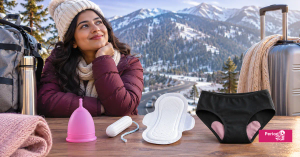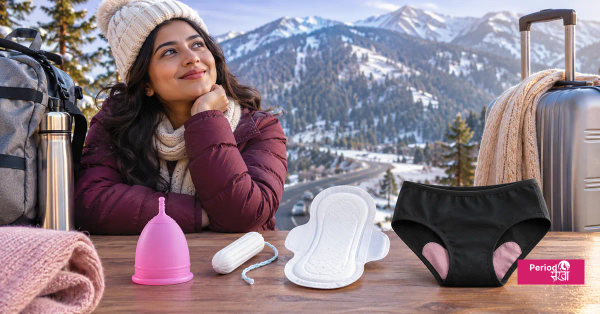

The mountains don't wait for your period to end. Neither should your travel plans. Indian solo traveller and author Shivya Nath has spoken about how she made menstrual cups work during long journeys, hikes, swims and beach trips. In an interview with Condé Nast Traveller India, she described how the cup initially felt intimidating. It took her time to become comfortable with insertion and removal, but eventually became a useful part of her travel routine. For her, the ability to travel without repeatedly worrying about changing disposable products made a difference. Her experience brings up an interesting question: how much of our travel planning actually accounts for menstruation?
Imagine reaching a small mountain town after an overnight bus journey. It is cold, your hotel room is not ready, your backpack is still on your shoulders, and your period has arrived a day earlier than expected. The nearest pharmacy may be several kilometres away. You have a trek planned for the following morning, and the public washroom at the bus stand is hardly inviting. For a woman travelling alone, these are not particularly unusual logistical problems. There may be nobody to lend her a sanitary pad, hold her luggage while she changes, or help her find a pharmacy in an unfamiliar place. Winter adds another layer of planning. Thick clothing, long journeys, limited access to clean washrooms and reusable products that take longer to dry can all influence menstrual management.
The answer is not to carry every menstrual product available. It is to understand which one works for your body and your travel plans. Let's compare four options, keeping the realities of solo female travel in mind.
For women who prefer not to insert anything vaginally, sanitary pads remain a practical choice. They are available in different absorbencies and lengths, are easy to replace and do not require water for routine use.
For a solo traveller, familiarity can be a significant advantage. You do not need to learn a new technique while staying in an unfamiliar hotel or using a shared washroom at a railway station.
Where pads work particularly well:
Overnight train and bus journeys.
Destinations where access to clean water is uncertain.
Women who experience discomfort with internal menstrual products.
Travellers who prefer easy replacement and disposal.
Where they become inconvenient:
Long hours of walking, sweating and sitting in thick winter clothing can make a damp pad uncomfortable. Friction may cause irritation, especially during trekking or extended outdoor activities.
Disposal is another consideration. Some remote washrooms may not have appropriate bins. Used pads should be wrapped and placed in a waste bin, or carried in a suitable disposal bag until one is available. They should never be flushed.
The solo traveller's approach: Carry your usual brand and absorbency rather than depending on local shops. Keep a few extra pads in your day bag, not just your main suitcase.
Tampons absorb menstrual blood inside the vagina. They are compact, lightweight and useful for women who prefer not to wear an external pad.
They can be especially convenient during activities such as swimming, hiking and sightseeing.
However, there are important precautions. Tampons should be changed every four to eight hours and never worn for more than eight hours. Choose the lowest absorbency suitable for your flow because prolonged use and inappropriate absorbency are relevant considerations in toxic shock syndrome (TSS), a rare but serious condition.
Where tampons work particularly well:
Swimming holidays.
Long sightseeing days.
Active travel and trekking.
Travellers who prefer minimal external bulk.
Where they become inconvenient:
You need a suitable washroom for changing, and disposal may be difficult in remote locations. If you have never used tampons before, do not make your first attempt during an overnight bus journey.
The solo traveller's approach: Carry tampons in a small waterproof pouch with a few tissues and disposal bags. Keep a familiar external backup product in your bag, especially if you are travelling somewhere with limited facilities.
Menstrual cups collect menstrual fluid rather than absorbing it. Most reusable cups are made from medical-grade silicone and can be used over multiple cycles when cleaned and maintained according to the manufacturer's instructions.
For a woman travelling alone, a cup can reduce the number of disposable products she needs to carry.
This is particularly useful when the itinerary includes several days in remote areas, long bus journeys or destinations where familiar sanitary products may be difficult to find.
Where menstrual cups work particularly well:
Multi-day trekking trips.
Long-distance journeys.
International travel.
Swimming and beach holidays.
Women who are comfortable managing reusable products independently.
Where they become inconvenient:
A cup needs to be emptied and cleaned. The absence of a private washroom or accessible washbasin can make this uncomfortable. Most cups can be worn for up to 8–12 hours, depending on their capacity, flow and manufacturer instructions. Heavy bleeding may require more frequent emptying. There is also a learning curve. Insertion, removal and positioning should be practised at home over several cycles before relying on a cup during travel.
The solo traveller's approach: Carry the cup in a clean storage pouch, a small bottle of potable water if needed, and a familiar backup product. If you cannot wash it properly in a public toilet, plan to empty it and clean it safely at the next suitable opportunity, following the manufacturer's instructions.
Period underwear contains absorbent layers designed to collect menstrual fluid. Some women use it independently, while others wear it alongside a tampon or menstrual cup for additional protection against leaks.
For women travelling alone, it can be particularly useful because it does not require insertion or frequent access to a washroom when used within its absorbency limits.
Where period underwear works particularly well:
Overnight stays.
Light-flow days.
As additional protection against leaks.
Women who prefer reusable external products.
Where it becomes inconvenient:
Winter drying conditions.
A pair of period underwear may take considerably longer to dry when the air is cold or humid. If you are staying in a hostel, moving between hotels or spending nights in a tent, washing and drying reusable underwear can become a logistical challenge.
Carrying only one pair is rarely practical for a multi-day trip.
The solo traveller's approach: Carry enough pairs to allow for washing and complete drying. Keep a separate waterproof bag for used underwear and follow the manufacturer's washing instructions. Never wear a damp pair simply because you have run out of alternatives.
Choosing a product is only one part of the equation. The bigger challenge is managing menstruation when you are responsible for your own luggage, transport, accommodation and personal safety.
Here are five situations worth thinking about before leaving home.
You have booked a sleeper berth. The journey is scheduled for nine hours, and your period arrives unexpectedly.
You wake up at a station, need to change your sanitary pad and realise that your main menstrual kit is inside the large suitcase placed under the berth.
This is why keeping supplies accessible matters.
Keep two or three menstrual products, spare underwear, tissues and disposal bags in a small pouch inside your personal day bag.
If you use a tampon, remember the eight-hour maximum wear time. If you use a cup, consider your flow and the recommended emptying interval.
A small personal pouch can make a surprisingly large difference when you do not have someone travelling with you.
This is one of the situations where menstrual cups can be useful for experienced users.
However, a cup does not remove the need for hygiene. You still need clean hands and a safe way to empty and clean it.
For a trek, plan your breaks rather than waiting until the cup is uncomfortable or full. Carry a small bottle of potable water, tissues and a waste bag.
If you use disposable products, remember that remote trekking routes may not have bins. Pack used products out responsibly rather than leaving them behind.
A reusable product may reduce waste, but it should never be used without considering whether you can maintain adequate hygiene.
Shared bathrooms can make changing menstrual products uncomfortable, particularly when there is limited space to keep personal belongings.
Keep your menstrual supplies together in a small opaque pouch. Take the entire pouch into the washroom rather than carrying loose products in your hands.
For reusable cups, make sure you have access to clean water and can wash your hands before handling the product.
If you use period underwear, plan where you will wash it and how you will dry it privately. A reusable wet bag can help with temporary storage, but it should not be used as a substitute for washing and drying.
This is more common than people expect.
A product familiar to you at home may not be available in the same form or absorbency abroad. In smaller towns, remote destinations and some rural regions, the selection may be limited.
Do not assume that you will be able to purchase the exact product you use at home.
Pack enough supplies for the expected duration of your period, with an additional allowance for unexpected delays or early bleeding.
For international travel, keep essential menstrual products in your cabin bag rather than your checked luggage.
A menstrual leak can happen regardless of the product you use.
Perhaps you have been walking for hours, your period is heavier than expected, or your journey has been delayed.
Keep a spare pair of underwear and a lightweight change of clothing in your personal bag. Dark-coloured trousers or leggings can also be useful if they make you feel more comfortable, although they are not a substitute for adequate menstrual protection.
If you need help, asking another woman at a hostel, café or public facility for a sanitary pad is perfectly reasonable. Menstrual supplies are ordinary personal-care items, and there is no reason to feel embarrassed about asking.
Rather than choosing a product based on popularity, consider the kind of holiday you are planning.
Travel situation | Practical choice | Why |
|---|---|---|
Overnight train | Familiar pad or experienced cup | Depends on access to washrooms and individual comfort |
Long-distance bus | Familiar pad or experienced cup | Fewer convenient opportunities to change |
Multi-day trekking | Experienced cup or tampons | Compact and suitable for outdoor activity |
Swimming holiday | Tampon or cup | Internal collection avoids absorbing pool water |
Hostel stay | Any familiar product | Depends on bathroom and laundry access |
Winter camping | Familiar disposable product or experienced cup | Drying and water access need planning |
Long hotel stay | Any preferred product | More convenient cleaning facilities |
Light-flow days | Pad, liner or period underwear | Depends on individual flow and comfort |
There is no universal winner. A product that works wonderfully for a mountain trek may be inconvenient in a hostel with poor bathroom facilities.
Reusable menstrual products are often recommended for their convenience and environmental benefits. But travel introduces practical difficulties that are easy to overlook. Consider a woman staying in a small homestay in the hills. She washes her period underwear in the evening, hangs it near a window and wakes up to find it still damp.
What should she do?
The answer is simple: do not wear it until it is completely dry. Cold or humid conditions can delay drying. Plan to carry sufficient pairs so that you are not dependent on overnight drying. For menstrual cups, the concern is different. You need access to safe water for rinsing and must follow the manufacturer's cleaning and sterilisation instructions between cycles. For disposable products, disposal becomes the primary challenge. Some remote toilets have no bins, so carrying opaque disposal bags is useful. A reusable product is not automatically the more practical option in every travel situation. Sustainability should be balanced with personal hygiene and realistic access to facilities.
Think of this as a small personal-care kit rather than an additional suitcase.
The essentials:
Your preferred menstrual products.
Enough additional supplies for unexpected delays.
One or two spare pairs of underwear.
Tissues or toilet paper.
Small disposal bags.
Hand sanitiser for situations where soap and water are unavailable.
A small bottle of potable water if you use a menstrual cup and may need it.
A reusable waterproof pouch.
Your usual menstrual pain-relief medication, if medically suitable for you.
A heat patch or compact hot-water bag if you usually use heat for cramps.
Keep your menstrual kit in your day bag, not buried inside your main luggage.
For solo travellers, accessibility is as important as quantity. You should be able to reach your supplies without unpacking your entire backpack in a public place.
One important point: Do not reduce your water intake to avoid using public toilets. Dehydration is not a sensible way to manage menstruation during travel. Plan toilet breaks instead.
Travel can sometimes coincide with changes in menstrual timing. However, cold weather itself should not be assumed to cause irregular periods. Changes in sleep, stress, physical activity, eating patterns and time zones may affect the menstrual cycle in some women.
A traveller who is suddenly trekking several hours a day, sleeping at different times and eating irregularly may notice a change in her usual cycle. A period arriving a few days earlier or later does not necessarily indicate a medical problem. However, repeated irregularity, unusually heavy bleeding or missed periods should be discussed with a gynaecologist.
If you have a history of endometriosis, severe dysmenorrhoea or heavy menstrual bleeding, plan your trip with your usual medical needs in mind. Do not start hormonal medication to delay menstruation simply because a trip is approaching. If you are considering menstrual suppression, discuss the options, suitability and possible risks with a gynaecologist in advance.
Menstrual care is also part of personal travel safety.
A few practical habits can make managing your period easier:
Keep menstrual products and essential medication in your personal bag.
Avoid leaving your backpack unattended in public washrooms.
Carry your own toilet paper or tissues when travelling to remote destinations.
Identify pharmacies and medical facilities near your accommodation.
Keep a trusted contact informed about your itinerary if you are travelling through isolated areas.
Do not experiment with unfamiliar menstrual products immediately before a demanding journey.
Carry additional products if your cycle is unpredictable.
There is no need to make menstruation the centre of your travel experience. But a little preparation can prevent it from becoming an avoidable source of stress.
Menstruation should not prevent you from travelling, but certain symptoms deserve medical attention.
Seek advice if you experience:
Bleeding that soaks through a pad or tampon every hour for several consecutive hours.
Severe abdominal or pelvic pain.
Persistent vaginal itching or unusual discharge.
Fever, dizziness or fainting.
Repeated difficulty inserting or removing a menstrual cup or tampon.
Unusual bleeding between periods.
If you use tampons and develop sudden fever, vomiting, diarrhoea, dizziness, faintness or a rash, remove the tampon and seek urgent medical care because these can be symptoms of toxic shock syndrome. Women with known gynaecological conditions should discuss any specific travel concerns with their treating doctor before undertaking strenuous or remote trips.
If you are comfortable with a menstrual cup and have practised using it, it can be a very convenient option for long journeys, trekking and destinations where disposable products are difficult to find. If you prefer something straightforward, sanitary pads remain a perfectly reasonable choice. Tampons are useful for active holidays and swimming, while period underwear can provide additional protection or serve as a primary product when you have enough pairs and suitable washing facilities. You do not need to become a menstrual cup user to be a confident traveller. Nor do you need to abandon disposable products to make your travel more sustainable. The best menstrual product is the one you understand, trust and can manage independently.
There is something particularly empowering about travelling alone. You learn to navigate unfamiliar streets, manage unexpected delays, find your way through new places and become comfortable relying on your own decisions. Managing menstruation is simply another part of that independence. As Shivya Nath's experience illustrates, finding a menstrual product that works for your lifestyle can make travel easier, but getting comfortable with it takes time. The goal is not to have a perfect period while travelling. The goal is to know what to do when it arrives, even if you are thousands of kilometres away from home. Pack thoughtfully, understand your body's needs, keep a backup plan and allow yourself to enjoy the journey.
Because a mountain, a coastline or a new city should not have to wait for your menstrual calendar.
This article is intended for educational purposes only. It draws on available scientific literature, published travel experiences and established guidance on menstrual products and hygiene. The travel scenarios are illustrative and are not presented as actual patient experiences.
Condé Nast Traveller India – Women's Day: 5 Women Travellers Recommend the Hygiene Products They Trust. Includes the experiences of solo traveller and author Shivya Nath and travel writer Neha Dara.
Van den Berg, M. et al. – Healthy, safe and responsible: the modern female traveller. Journal of Travel Medicine and Infectious Disease, 2021. Discusses menstrual hygiene challenges, product selection and practical considerations for women travelling alone.
US Food and Drug Administration – Menstrual Product Options, Facts, and Safe Use.
US Food and Drug Administration – The Facts on Tampons and Tampon Safety.
Condé Nast Traveller – The Unexpected Upsides of Travelling on Your Period. Personal accounts from women who have travelled while menstruating.
Dr. Akanksha is a dedicated dental professional and health educator who believes that healthcare goes beyond treatment-it is about creating awareness, building trust, and empowering individuals to make informed decisions about their well-being. Alongside her clinical expertise in dentistry, she is deeply passionate about public health education, with a special focus on menstrual health, hygiene, and women's wellness.
About PeriodSakhi
PeriodSakhi is your trusted companion for understanding your menstrual health. With easy-to-use tools, it helps you track your periods, ovulation, fertility, moods, and symptoms, while providing insights into your overall reproductive and hormonal health. PeriodSakhi also serves as a supportive online community where women can share experiences, find reliable information, and access expert-backed guidance on menstrual health, PCOS, pregnancy, lifestyle, and more.
Disclaimer
The views, thoughts, and opinions expressed in this article/blog are solely those of the author and do not necessarily reflect the views of PeriodSakhi. Any omissions, errors, or inaccuracies are the responsibility of the author. PeriodSakhi assumes no liability or responsibility for any content presented. Always consult a qualified medical professional for specific advice related to menstrual health, fertility, pregnancy, or related conditions.