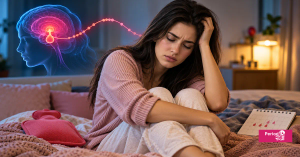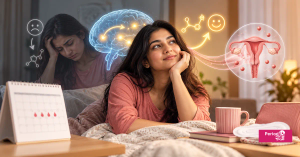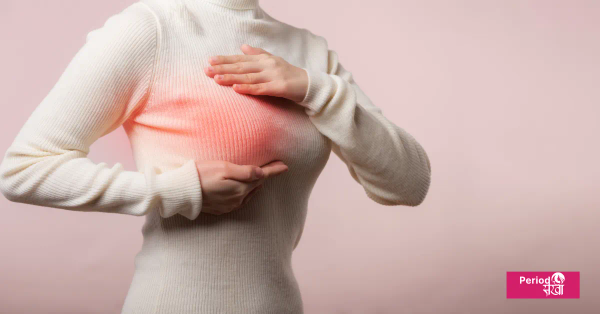

For some women, the days before a period bring more than mood changes, bloating or cramps. The breasts may suddenly feel swollen, heavy, tender or even painful. They may also feel different to the touch slightly firmer, lumpier or fuller than usual.
This can be frightening, particularly when a woman notices a lump for the first time.
“Mum, I think there is something wrong with my breast.”
Sixteen-year-old Riya was standing in front of the mirror, looking worried.
Her mother came over. “What happened?”
“I can feel a lump here. And my breast hurts. Is it cancer?”
Her mother looked concerned too, but instead of trying to guess what it was, she said, “Let's get it checked. Breast tissue can change during your period, but a doctor can tell you what is normal for you.”
This is an important message. Breast pain and temporary lumpiness around a period are very common and are usually caused by normal hormonal changes. Breast pain on its own is rarely a sign of breast cancer but knowing what is normal and knowing when a change should be checked — can make a big difference.
Breast pain that follows a predictable pattern around the menstrual cycle is called cyclical breast pain, or cyclical mastalgia.
It is closely linked to the natural rise and fall of reproductive hormones during the menstrual cycle.
The pain commonly:
begins several days to two weeks before a period;
gradually becomes more noticeable as the period approaches;
affects both breasts, although one breast may sometimes be more uncomfortable;
causes tenderness, heaviness, fullness or aching;
may be associated with temporary swelling or lumpiness; and
improves when the period starts or shortly afterwards.
Some women describe the sensation as:
“My breasts feel heavy.”
Others say:
“They hurt when I touch them.”
Some experience burning, tightness, prickling or an aching sensation.
There is no single way cyclical breast pain feels. It can range from barely noticeable discomfort to pain that interferes with exercise, sleep or daily activities.
Around two-thirds of women experience cyclical breast pain at some point, although the severity varies considerably.
The main reason is hormonal fluctuation.
During the menstrual cycle, the ovaries produce changing amounts of hormones, particularly oestrogen and progesterone.
After ovulation, progesterone rises and oestrogen remains active. These hormones act on breast tissue because the breast contains hormone-sensitive structures, including the milk ducts and lobules.
The body is essentially preparing the breasts for a possible pregnancy.
The breast tissue can therefore:
retain more fluid;
become slightly swollen;
become more sensitive;
feel heavier;
feel firmer or more nodular; and
become painful or tender.
If pregnancy does not occur, oestrogen and progesterone levels fall. The hormonal stimulation of the breast tissue also reduces, and the swelling and tenderness generally settle.
So, in simple terms:
Hormones rise → breast tissue responds → breasts may swell and become tender → hormones fall → symptoms usually settle.
This is why the timing of the pain matters so much.
Breast tissue is not completely static throughout the month.
Around the middle of the cycle, hormonal activity increases. Some women begin to notice subtle breast fullness or sensitivity.
Progesterone rises. The breast glands and supporting tissue can become more active, and some women start to notice tenderness or lumpiness.
This is when symptoms are often most noticeable.
The breasts may feel:
fuller;
heavier;
swollen;
tender;
painful;
slightly firmer; or
more “lumpy” than usual.
The upper outer part of the breast can feel particularly prominent because it contains a relatively large amount of glandular tissue. The discomfort can sometimes extend towards the armpit.
Hormone levels fall. Fluid retention and hormonal stimulation decrease.
For many women, breast pain begins to improve around the start of the period and settles soon afterwards.
This is often the part that causes the most anxiety.
Normal breast tissue is not always completely smooth. It can naturally feel soft, firm, nodular or slightly rope-like.
During the menstrual cycle, hormonal changes can make this normal tissue feel more prominent than usual.
A woman may therefore think:
“I never had this lump before.”
But sometimes the tissue was always there; it has simply become easier to feel because the breast is temporarily swollen or tender.
This is particularly common with fibrocystic breast changes.
The term “fibrocystic breast disease” is now used less often because these changes are generally considered a common variation of breast tissue rather than a disease. Fibrocystic changes can include areas of fibrosis, enlarged lobules and fluid-filled cysts.
The lumpiness can fluctuate with the menstrual cycle.
There is no single normal size for cyclical breast swelling or a cyclical lump.
This is important.
A normal hormonal change is not defined by a particular measurement such as 1 cm, 2 cm or 5 cm.
The breast contains glandular, fatty and connective tissue, and the amount of swelling varies greatly between individuals.
A small area of thickening may become noticeable to one woman, while another may experience more widespread fullness throughout both breasts.
Breast cysts can also vary considerably in size, from a few millimetres to several centimetres. Some become larger and more painful immediately before a period and then become smaller afterwards.
What matters more than the exact size is the behaviour of the lump.
A lump that becomes noticeable before every period and then becomes smaller or disappears afterwards is generally less concerning than a new lump that remains unchanged or continues to grow.
However, a new or persistent lump should not simply be assumed to be hormonal.
There is a wide range of normal.
These may include:
slight breast tenderness;
mild swelling;
increased nipple sensitivity;
a feeling of fullness;
slightly firmer breast tissue;
mild lumpiness that disappears after the period.
These changes usually do not require treatment.
Some women experience:
significant breast enlargement or fullness;
painful nodules;
several areas of lumpiness;
pain extending towards the armpit;
considerable tenderness when wearing a bra or exercising.
These symptoms can still be hormonal, particularly when they follow the same menstrual pattern every month.
You should arrange a medical assessment if you notice:
a new lump that remains after your period;
a lump that continues to increase in size;
a hard or fixed lump;
persistent pain in one specific area;
skin dimpling or puckering;
a new change in breast shape;
a nipple that has recently become inverted;
bloody nipple discharge;
persistent unusual nipple discharge;
redness, warmth or swelling, particularly with fever; or
a new lump in the armpit.
These signs do not automatically mean cancer. Many breast lumps are benign. They simply mean that the change deserves proper assessment rather than being attributed to periods without checking.
Often, yes.
Cyclical breast pain commonly improves when the period starts or shortly afterwards. In some women, it may disappear completely for months and then return.
For others, it continues for several cycles.
Hormonal contraception can also influence breast pain. Some women notice breast tenderness after starting or changing a hormonal contraceptive, while others notice improvement. Hormone replacement therapy can also cause breast tenderness.
Cyclical breast pain generally becomes less common after menopause, although women taking hormone replacement therapy can still experience it.
When Riya eventually saw her doctor, she was visibly nervous.
Riya: “Doctor, I can feel a lump and my breast hurts. I am really scared.”
Doctor: “When did you first notice it?”
Riya: “About a week before my period.”
Doctor: “Has this happened before?”
Riya: “I don't know. I never checked properly.”
Doctor: “And what happens when your period comes?”
Riya: “The pain usually gets better.”
The doctor examined her and explained:
Doctor: “Breasts naturally change during the menstrual cycle. Hormones can make them swollen and lumpy, and that can make normal tissue feel like a lump. The fact that your symptoms follow your period is reassuring, but we don't diagnose a breast lump based on timing alone. If a lump persists, changes or looks unusual, we investigate it.”
Riya: “So breast pain doesn't mean cancer?”
Doctor: “Breast pain by itself is very rarely the only sign of breast cancer. But any new or persistent breast change should be assessed properly.”
That distinction is important.
Reassurance does not mean ignoring a breast change.
It means understanding which patterns are commonly hormonal while knowing which changes require further assessment.
The first step is usually a detailed history and clinical breast examination.
A doctor may ask:
When did the pain begin?
Is it present in one or both breasts?
Does it occur at the same point in each menstrual cycle?
Does it improve after the period?
Have you noticed a lump?
Does the lump change in size?
Are there nipple or skin changes?
Are you taking hormonal contraception?
Could you be pregnant?
Have you had any injury to the breast?
Is there a family history of breast problems or breast cancer?
Doctors may also ask you to keep a breast-pain diary for a few weeks or menstrual cycles. This can help establish whether the symptoms are genuinely cyclical.
Importantly, imaging is not automatically required for every woman with cyclical, diffuse breast pain and no suspicious finding. The American College of Radiology considers routine imaging usually inappropriate for clinically insignificant diffuse or cyclical breast pain without another suspicious clinical finding.
If there is a persistent lump or another concerning finding, however, the doctor may recommend imaging such as an ultrasound or mammogram depending on the person's age, examination findings and clinical situation.
Fortunately, simple measures are often enough.
A properly fitting, supportive bra can reduce breast movement and discomfort. This can be particularly helpful during exercise.
Record:
first day of your period;
day breast pain begins;
severity of pain;
whether one or both breasts are affected;
any lumpiness;
when the symptoms disappear.
After two or three cycles, the pattern can become much clearer.
If appropriate for you, simple painkillers such as paracetamol or an anti-inflammatory medicine may help. However, anti-inflammatory medicines are not suitable for everyone, so ask a pharmacist or doctor if you are unsure.
Regular physical activity, adequate sleep and a balanced diet are sensible measures for overall health.
Some women find that reducing caffeine or alcohol helps, although evidence for dietary changes specifically treating cyclical breast pain is limited.
Constantly pressing a tender breast can make it more painful and can increase anxiety.
Instead, learn how your breasts normally feel and look, and pay attention to new, persistent changes.
This is generally due to hormonal effects, fluid changes and temporary changes in breast tissue rather than permanent breast growth.
The increase may be subtle and may not be measurable with a tape measure.
One woman may notice:
“My bra feels tighter.”
Another may notice:
“My breasts look fuller.”
Both can be normal.
The breasts generally return towards their usual size after menstruation.
However, a persistent change in breast size or shape that does not follow your menstrual cycle should be assessed.
This is perhaps the most important point.
A change is more likely to be cyclical when it:
affects both breasts;
appears around the same time each month;
is associated with tenderness;
becomes more noticeable before menstruation;
improves during or shortly after the period;
fluctuates in size.
Be more cautious if:
the lump remains after the period;
it continues to grow;
it feels hard or fixed;
there is a new persistent one-sided change;
the skin becomes dimpled or puckered;
the nipple changes position or becomes newly inverted;
there is bloody discharge;
there is persistent localised pain; or
there is an armpit lump.
Again, these findings do not mean that you have cancer. They mean that a clinician should examine you.
Yes. Cyclical breast pain is common and is usually related to hormonal changes during the menstrual cycle.
Hormonal changes can make normal glandular breast tissue more swollen and prominent. Fibrocystic changes and breast cysts can also become more noticeable around menstruation.
Yes. Hormonal swelling and some breast cysts can become smaller after menstruation. However, a new lump should still be monitored and medically assessed if it persists or changes.
Breast pain on its own is rarely a sign of breast cancer. Nevertheless, a new or persistent breast change should be checked rather than automatically blamed on hormones.
Although cyclical breast pain often affects both breasts, the severity does not have to be identical. One breast can feel more tender than the other.
Yes. Temporary fullness or mild enlargement can occur because of hormonal changes and fluid shifts.
It commonly begins in the days to two weeks before menstruation and improves when the period starts or shortly afterwards.
Stress and anxiety can be associated with breast pain, and worrying about a breast symptom can make the experience feel more intense.
You should become familiar with how your breasts normally look and feel. If you are investigating a new lump, it can be useful to see whether it changes after your period. But do not repeatedly press or squeeze a painful area.
See your GP or another qualified healthcare professional if you have a new or persistent lump, unexplained persistent pain, skin or nipple changes, bloody discharge, or a change that does not settle after your period.
Breasts are hormonally responsive organs, and they can change throughout the menstrual cycle.
Before a period, changing levels of oestrogen and progesterone can make breast tissue temporarily swollen, tender, heavy or lumpy. These changes are often most noticeable during the week or two before menstruation and usually improve when the period begins.
A small lump that appears before a period and becomes smaller afterwards can be part of normal cyclical breast changes. Cysts and fibrocystic changes can also fluctuate with the menstrual cycle.
But there is no reliable “normal lump size” that allows a woman to decide at home whether a lump is harmless. The pattern, persistence and other breast changes matter more than the measurement alone.
So if you notice something new, don't panic — but don't ignore it either.
Know your normal. Watch the pattern. And if a change persists, grows or looks unusual, get it checked.
For Riya, the conversation with her mother ended with a simple lesson:
“A change in your breast doesn't mean something terrible is happening. But it is always okay to ask a doctor.”
And that is exactly the right message to remember.
NHS. Breast pain. NHS website. Available at: NHS Breast Pain guidance
Breast Cancer Now. Breast pain. Available at: Breast Cancer Now – Breast Pain
Mayo Clinic. Fibrocystic breasts – Symptoms and causes. Available at: Mayo Clinic – Fibrocystic breasts
Mayo Clinic. Breast pain – Symptoms and causes. Available at: Mayo Clinic – Breast pain
American College of Radiology. ACR Appropriateness Criteria®: Breast Pain. Available at: ACR Appropriateness Criteria – Breast Pain
Mayo Clinic. Breast cysts – Symptoms and causes. Available at: Mayo Clinic – Breast cysts
About PeriodSakhi
PeriodSakhi is your trusted companion for understanding your menstrual health. With easy-to-use tools, it helps you track your periods, ovulation, fertility, moods, and symptoms, while providing insights into your overall reproductive and hormonal health. PeriodSakhi also serves as a supportive online community where women can share experiences, find reliable information, and access expert-backed guidance on menstrual health, PCOS, pregnancy, lifestyle, and more.
Disclaimer
The views, thoughts, and opinions expressed in this article/blog are solely those of the author and do not necessarily reflect the views of PeriodSakhi. Any omissions, errors, or inaccuracies are the responsibility of the author. PeriodSakhi assumes no liability or responsibility for any content presented. Always consult a qualified medical professional for specific advice related to menstrual health, fertility, pregnancy, or related conditions.