
“A girl should never have to whisper about the very thing her body is teaching her to become.”
For generations, menstruation has been treated as something to hide. A pad is quietly passed from one hand to another, wrapped in newspaper or an opaque bag. A daughter learns that she should not mention her period in front of her father. A schoolgirl stains her uniform and worries more about being seen than about being uncomfortable. A woman experiences severe pain but dismisses it as something she simply has to tolerate. Yet menstruation is neither shameful nor mysterious. It is one of the body’s most ordinary biological processes. The question is no longer whether girls should be taught about periods. The more important question is how early, how honestly and how compassionately we can begin the conversation.
Books and movements around menstrual education have helped open this door. Resources such as Menstrupedia Comic make puberty and menstruation understandable for younger readers, while books such as Period Power encourage older girls and young women to think about menstruation not only as biology, but also in terms of confidence, equality and the freedom to speak. Activists and educators working across the menstrual-health space have similarly broadened the conversation from the first period, or menarche, through reproductive health and eventually menopause.
Imagine a ten-year-old girl noticing that her body is changing.
Her breasts are developing. She is growing taller. She notices hair where there was none before. Perhaps she has heard classmates whispering about periods, but nobody has explained what they actually mean.
Then one morning, she sees blood on her underwear.
Without preparation, fear can arrive before understanding.
Now imagine the same girl having had a conversation with her mother a year earlier.
She knows that her body will gradually change. She knows that menstruation is one part of puberty. She knows that blood from the uterus can come out through the vagina every few weeks. She knows that cramps, mood changes, tiredness and changes in discharge can occur. She knows what a pad is, how to use it and whom she can ask for help. The blood has not changed but her experience has that is the power of education.
Children do not always learn best from formal lectures. Sometimes a story, illustration or relatable character can make an uncomfortable subject feel ordinary.
This is one reason resources such as Menstrupedia Comic can be useful for children and parents. Designed for young readers, it approaches puberty, menstruation, hygiene, nutrition, body changes and common myths in a simple and accessible way.
A book can also give a parent an opening.
Instead of sitting across from a daughter and announcing, “Today I am going to teach you about periods,” a parent can simply say:
“I found this book. Shall we read it together?”
That small difference can change the atmosphere completely.
The same principle applies as girls grow older. Younger children need simple explanations about body changes. Adolescents need more detailed information about cycles, pain, hygiene, nutrition, emotional changes and when to seek medical help. Young women may need conversations about contraception, fertility, endometriosis, PCOS, reproductive health and the transition towards menopause.
Menstrual education should therefore be age-appropriate, continuous and evolving.
One conversation is not enough.
Menstruation is personal, but it is also social.
Books and movements that approach menstruation through the lens of activism remind young people that periods have historically been surrounded by embarrassment, silence and unequal access to information and menstrual products.
For a teenage girl, this can lead to a powerful realisation:
My period is part of my body, but the shame attached to it was created by society.
That distinction matters.
Menstrual education should teach girls how their bodies work, but it should also give them the confidence to ask questions, challenge myths and speak when something does not feel right.
A girl should be able to say:
“My periods are extremely painful.”
“I am bleeding much more than usual.”
“I feel dizzy during my period.”
“I have not started menstruating yet and I am worried.”
“I think something about my cycle has changed.”
These are health conversations and not embarrassing confessions.
The first period is often remembered for years.
Unfortunately, many girls remember it because they were frightened.
Some were told not to tell anyone. Some were given a pad without an explanation. Some were introduced to a list of restrictions before they were taught what menstruation actually was.
Menarche deserves something different.
It can be a quiet conversation between a mother and daughter. It can be a father learning how to buy menstrual products without embarrassment. It can be a school teaching children what puberty means before anyone experiences it.
It does not have to become a dramatic ceremony.
It simply needs to become normal.
A parent can tell her daughter:
“Your body is changing, and that is okay.”
“You can always ask me anything.”
“You don’t have to feel ashamed of blood.”
“If your periods ever become difficult, we will find help.”
Those sentences may appear small, but they can stay with a girl for decades.
Parents do not need to be medical experts. They need to be available, honest and willing to listen.
Explain what menstruation is in simple language. Talk about the uterus, ovaries, menstrual cycle and vaginal bleeding in an age-appropriate way.
There is no need to use complicated terminology with a young child, but there is also no reason to replace correct anatomical words with vague expressions.
Children deserve accurate information about their bodies.
A girl should know how to use and change menstrual products, dispose of them responsibly and maintain personal hygiene.
She should also know that periods can look different from person to person. The amount of bleeding, duration of the cycle and symptoms can vary.
Most importantly, she should know what is normal for her and recognise when something has changed.
“Mothers have periods too, so just tolerate it” is not adequate health education. Mild cramps can be common, but severe or disruptive pain deserves attention. Excessive bleeding, fainting, persistent fatigue, unusually irregular periods or symptoms that interfere significantly with school and everyday life should not simply be dismissed as the price of being a woman.
The lesson should be simple:
You do not have to suffer silently to prove that you are strong.
Periods are not a reason to stop living normally, but the body deserves care. Children should gradually learn the importance of balanced meals, adequate iron, protein, hydration, sleep and physical activity. They should understand that caring for the body is not indulgence; it is basic health.
Hormonal changes can influence how someone feels, but menstruation should never become an excuse to dismiss a girl’s emotions. Instead of saying, “You’re behaving like this because you’re on your period,” parents can ask:
“You seem upset. Do you want to talk?”
That response teaches emotional awareness rather than shame.
Menstrual education should never be placed entirely on girls.
Boys need to understand periods too.
A boy who knows what menstruation is is less likely to laugh when a classmate asks for a pad. A brother who understands menstrual pain is more likely to show empathy. A future husband who has grown up with accurate information is less likely to treat menstruation as something disgusting or inconvenient.
Period education is therefore not only girls’ education.
It is human education.
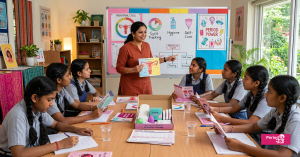
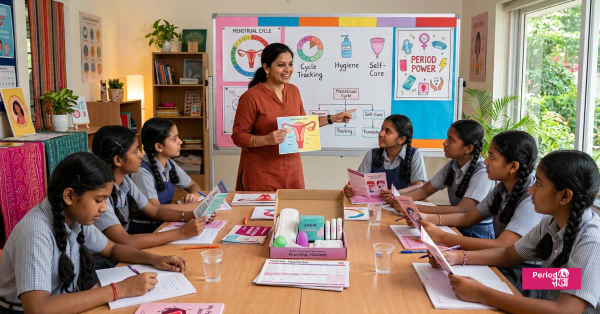
Schools can create age-appropriate conversations for all students rather than making menstruation a secret lesson given only to girls.
One of the biggest gaps in menstrual education is that it often begins with the first period and ends shortly afterwards but women’s reproductive health does not end at adolescence.
A woman may spend decades navigating menstrual cycles, contraception, pregnancy, fertility concerns, menstrual disorders and changing hormones. Eventually, she may experience perimenopause and menopause.
The same principle applies throughout:
Understand your body before you are forced to understand it through a problem.
A young girl learning about menarche today is also learning the foundation for understanding her health as an adult. She should grow up knowing that menstruation changes across life—and that asking questions at every stage is normal.
There is no single perfect birthday for the conversation.
The simplest rule is:
Teach before the child needs the information.
A five- or six-year-old may simply learn that boys and girls’ bodies change as they grow.
Around primary-school age, parents can introduce puberty and basic menstruation.
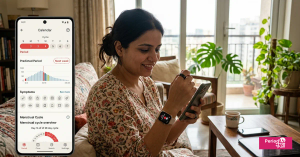
As puberty approaches, the conversation can become more detailed: menstrual products, hygiene, cramps, discharge, emotional changes, tracking cycles and when to seek help.
Teenage years can bring deeper conversations about reproductive health, sexual health, consent, fertility and menstrual disorders.
And the conversation should remain open into adulthood.
There should never be a final chapter called “Now you know everything.”
Awareness is the first step, not the destination.
A girl knowing the word “menstruation” is useful. A girl knowing what to do when her period arrives unexpectedly at school is better.
A school conducting a one-day menstrual workshop is valuable. A school ensuring access to clean toilets, water, menstrual products and a safe adult to approach is better.
A parent giving her daughter a book is wonderful. A parent who also listens without embarrassment is even more important.
A society posting messages about period positivity is encouraging. A society where women can talk about menstrual health without shame is the real goal.
This is how period power becomes peaceful periods: when information moves from books into homes, classrooms, conversations and everyday life.
Perhaps the most important thing a parent can give a daughter is not a packet of pads or even a beautifully illustrated book. It is the certainty that her body is not something she needs to apologise for. She should be able to grow up knowing that blood does not make her dirty, cramps do not make her weak, asking questions does not make her immature and seeking medical help does not make her dramatic and when she eventually becomes the woman who has to explain menstruation to another little girl, she should not have to repeat the silence she inherited.
She can choose something different. She can sit beside her daughter, sister, student or younger cousin and say: “You can talk to me. There is nothing about your body that you need to be ashamed of.” That is where menstrual education truly begins.
Not with a textbook.
Not with a campaign.
Not even with the first period.
It begins with a conversation, and with the decision to make that conversation safe.
About PeriodSakhi
PeriodSakhi is your trusted companion for understanding your menstrual health. With easy-to-use tools, it helps you track your periods, ovulation, fertility, moods, and symptoms, while providing insights into your overall reproductive and hormonal health. PeriodSakhi also serves as a supportive online community where women can share experiences, find reliable information, and access expert-backed guidance on menstrual health, PCOS, pregnancy, lifestyle, and more.
Disclaimer
The views, thoughts, and opinions expressed in this article/blog are solely those of the author and do not necessarily reflect the views of PeriodSakhi. Any omissions, errors, or inaccuracies are the responsibility of the author. PeriodSakhi assumes no liability or responsibility for any content presented. Always consult a qualified medical professional for specific advice related to menstrual health, fertility, pregnancy, or related conditions.