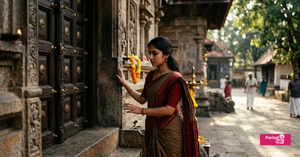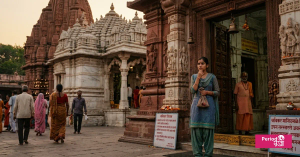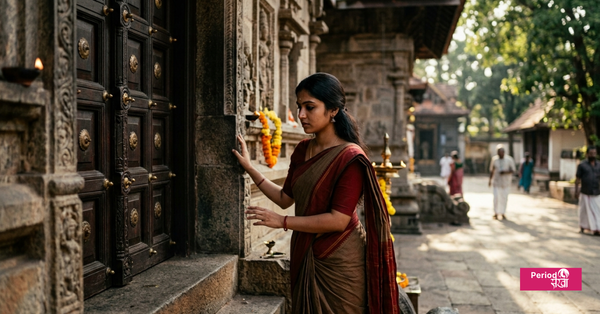

Picture this, a girl gets her first period. She might be frightened, confused, perplexed or even unsure about what is actually happening to her body. Then, instead of simply being told that menstruation or periods is a normal biological process, she may also hear that she cannot enter the temple, cannot participate in a religious celebration, cannot touch certain objects or should stay away from other family members.
For an adult who has grown up with these practices, they may seem like ordinary traditions. For a young girl experiencing menstruation for the first time, however, the message can be very different.
She may wonder: Am I dirty? Have I done something wrong? Why can everyone else pray but not me? Why is something happening naturally inside my body stopping me from being part of a celebration?
This is where the discussion around menstruation, faith and temple access becomes more than a religious debate. It becomes a conversation about health, dignity, inclusion and how we teach the next generation about the female body.
Inclusion means ensuring that people are able to participate in social, cultural and community life without being unnecessarily excluded because of who they are or because of a normal biological condition.
In the context of menstruation, inclusion does not necessarily mean that every temple must follow exactly the same ritual practice. Religious communities have different beliefs, traditions and rules.
Menstrual inclusion means something more fundamental: a menstruating woman or girl should not be treated as dirty, sinful, dangerous or less worthy simply because she is menstruating.
It also means that a girl should have access to accurate information, sanitation, menstrual products, emotional support and the freedom to understand her own body without shame.
This distinction is important. A religious practice may have a spiritual explanation within a particular tradition, but a cultural restriction should not automatically be presented as a medical fact.
Menstruation occurs when hormonal changes lead to the shedding of the uterine lining when pregnancy has not occurred. Menstrual blood is made up mainly of blood, tissue from the uterine lining and vaginal and cervical secretions.
It is not toxic blood.
It does not make a woman biologically impure.
It does not carry a special substance that can spoil food, damage plants, contaminate religious objects or harm another person simply because it is menstrual blood.
A systematic review and meta-analysis of menstrual hygiene among adolescent girls in India found that restrictions on religious participation were among the most commonly reported menstrual restrictions. The review reported a pooled prevalence of around 77% for restrictions on visiting places of worship and around 71% for restrictions on touching religious items or praying, although the studies varied substantially. (BMJ Open)
This tells us that religious restrictions around menstruation are socially significant. It does not establish that they have a medical basis.
There is no single origin story for every menstrual restriction in India.
India has always contained multiple religious, regional, caste, tribal and cultural traditions. Practices around menstruation have therefore varied greatly across communities.
Some classical Hindu texts did associate menstruation with ritual impurity or temporary separation. Dharma literature, including the Manusmriti and other texts, contains rules concerning menstruating women and ritual purity. Scholars have also connected these rules with wider ancient ideas about bodily substances, purity, caste and ritual boundaries. (NCBI)
Some traditions also developed narratives linking menstruation with religious stories. One example discussed in scholarship is the Vedic story involving Indra and the transfer of guilt, which later became associated with the interpretation of menstrual blood as a form of impurity. (NCBI)
But it is important not to make a sweeping statement that “Hinduism says menstruating women are impure.”
Hindu traditions are not a single uniform system. Different communities have interpreted menstruation differently, and there are also traditions that associate menstruation and female reproductive power with fertility, Shakti and sacredness.
Therefore, the more accurate statement is that some Hindu religious and social traditions developed rules of ritual separation around menstruation, while other traditions have understood the menstruating body differently.
This is where history becomes particularly interesting.
Ancient India had a substantial medical tradition. Ayurveda developed detailed discussions of reproduction, menstruation, pregnancy, childbirth and childhood health.
The Charaka Samhita and Sushruta Samhita discuss female reproductive health and menstrual disorders. Classical Ayurvedic literature includes descriptions of disorders involving abnormal bleeding, absent menstruation, painful menstruation and other gynaecological conditions. (Wisdom Library)
The Sushruta Samhita also describes menstrual blood, conception, pregnancy, fetal development, childbirth and care during pregnancy. (Wikisource)
The Charaka Samhita contains discussions of pregnancy care and describes maternal health as important for the developing fetus. Later interpretations of its prenatal-care framework include attention to physical, psychological, social and spiritual aspects of maternal wellbeing. (Caraka Samhita Online)
Ayurveda also developed specialised branches concerned with areas such as paediatrics and reproductive health. The Kashyapa Samhita, for example, is strongly associated with the ancient Ayurvedic branch of Kaumarabhritya, or child health. (IJAPR)
This does not mean ancient Indian medicine was equivalent to modern gynaecology. It was based on a very different medical framework, and many of its explanations cannot be scientifically accepted today.
But it does show something important: the female reproductive system was not ignored by ancient Indian medical thinkers.
One possible reason menstrual practices survived is that some restrictions may originally have had practical elements.
Before modern sanitation, running water, disposable menstrual products, washing facilities and pain medication, menstruation could be physically difficult to manage.
A woman experiencing heavy bleeding or menstrual pain might genuinely have benefited from reduced physical workload.
Ancient texts also recommended periods of reduced activity or separation during menstruation. For example, some classical Ayurvedic instructions describe abstinence from sexual activity during menstruation and specific routines during the first few days. (siva.sh)
But there is an important difference between:
“You can rest if your body needs it.”
and
“You are not allowed to participate because your body is impure.”
The first can be health supportive.
The second can become stigma.
Modern menstrual health therefore encourages choice. A woman who has cramps, heavy bleeding, migraine or fatigue may reasonably choose rest. Another woman may feel perfectly well and continue working, exercising, travelling or participating in religious and social activities.
Traditions rarely survive simply because people have independently reconsidered all the evidence behind them.
They survive because they are passed from one generation to another.
A mother teaches her daughter what her mother taught her. A grandmother teaches a child what was taught to her. A family follows a ritual because it has always been followed.
Over time, the original reason may become unclear.
Research among Indian women has shown that menstrual practices can change over generations. A study of Havik Brahmin women in Karnataka, for example, documented changes in menstrual pollution and purity rituals over time, including a movement from religious ritual toward hygiene-based practices. (PubMed)
This is an important lesson about tradition.
Tradition can preserve valuable knowledge, but tradition can also preserve practices whose original context has changed.
The fact that something is old does not automatically make it medically necessary. At the same time, questioning a practice does not require disrespecting the people who follow it.
There is currently no established medical evidence that menstruation itself makes a woman incapable of entering a temple or participating in prayer.
There is also no scientific evidence that menstrual blood has a special property that makes religious objects unsafe to touch or causes food, plants or sacred spaces to become contaminated merely through contact with a menstruating woman.
This distinction should be stated clearly.
A religious community may have a theological or ritual reason for restricting participation. That is different from saying that science proves menstruating women should be excluded.
Science can study menstruation, hormones, menstrual blood, infection, hygiene and health. It cannot scientifically prove or disprove a theological belief about ritual purity.
Therefore, if a priest or religious teacher gives a spiritual explanation for a temple’s rule, that explanation belongs to the religious framework of that temple. It should not be presented as established medical science unless there is actual scientific evidence supporting it.
Some religious explanations suggest that menstruation involves a particular energy state, that rituals require a particular form of purity or that entering a sacred space during menstruation may interfere with a deity, ritual or spiritual process.
These beliefs can be meaningful to followers.
However, claims about invisible spiritual energy are not the same as scientifically demonstrated physiological mechanisms.
There is no established scientific evidence showing that menstruation changes a woman’s body in a way that makes her physically incapable of performing a ritual.
It is therefore possible to respect a person’s religious belief while still being precise about what science can and cannot establish.
A priest can explain why a tradition is followed within his or her religious interpretation.
A doctor or researcher is needed to establish whether a claim has medical or biological evidence.
Keeping these two forms of knowledge separate can actually make conversations about religion more respectful, rather than less.
This may be the most important part of the conversation.
Menarche, or the first menstrual period, is a major developmental event. It occurs during adolescence, a period when children are already developing their identity, body image and understanding of social acceptance.
Imagine a girl attending a family religious celebration.
She is excited. Everyone is dressed beautifully. There are prayers, food, relatives and celebrations.
Then she gets her first period.
Instead of being told, “Your body has started a normal new phase,” she is suddenly told that she cannot enter the temple, cannot participate in the prayer or must sit separately.
She may not understand the distinction between ritual restriction and personal worth.
She may simply hear:
“There is something wrong with me.”
Research among young women in Uttar Pradesh has found that many participants received messages that menstruation was dirty or impure and consequently avoided prayer or religious spaces. Importantly, the same research found that when mothers explained menstruation as natural and normal, girls reported feeling better and more comfortable. (PubMed Central (PMC))
UNICEF similarly reports that stigma and social exclusion around menstruation can affect confidence, mobility, school attendance and participation in community life. (UNICEF)
A recent 2026 study of Indian adolescents also specifically examined the emotional and psychological experience of menarche and the influence of preparedness, discussion and menstrual taboos. (ScienceDirect)
The problem, therefore, is not simply whether a girl enters a temple.
The deeper question is what meaning she attaches to being kept outside.
Faith can provide belonging, comfort and identity.
But when a child is taught that menstruation makes her dirty, dangerous or spiritually inferior, a religious practice can unintentionally become a source of shame.
This is particularly concerning when the girl does not understand menstruation biologically.
UNICEF India has documented examples of girls experiencing menarche without prior information and subsequently facing restrictions such as missing school, using inadequate menstrual materials and being prevented from participating in ordinary activities. (UNICEF)
Another UNICEF India account describes communities where girls were discouraged from entering prayer spaces or touching religious objects during menstruation. (UNICEF)
Such experiences can contribute to embarrassment, secrecy, anxiety and a negative perception of one’s own body.
This does not mean every girl who follows a menstrual restriction will experience psychological harm.
Some girls may understand it as a temporary religious practice and feel completely comfortable with it.
The concern arises when restriction is accompanied by shame, fear, humiliation or the message that the female body is inherently dirty.
The solution does not have to be a battle between science and religion.
Families and religious communities can preserve meaningful rituals while changing the language around menstruation.
For example, instead of telling a girl:
“You cannot enter because you are impure.”
a family could explain:
“Our family follows this particular religious tradition during menstruation. It is a ritual practice, not because you are dirty or unhealthy.”
That single difference can protect dignity.
A girl can understand that her family has a religious practice without believing that her body is shameful.
This approach also leaves space for different families and temples to make their own informed choices.
The debate is not theoretical.
In 2018, the Supreme Court of India delivered its judgment in Indian Young Lawyers Association v. State of Kerala, concerning the exclusion of women of menstruating age from Sabarimala Temple.
The case became one of the country’s most significant modern debates about gender, religion, equality and religious practice. Scholarship on the case also highlights how complicated the issue became, involving questions of religious autonomy, gender equality, tradition and competing interpretations of menstruation. (NCBI)
The Sabarimala debate demonstrated that menstrual restrictions cannot always be reduced to a simple question of whether menstruation is “pure” or “impure.”
They can involve:
religious belief
temple-specific traditions
gender equality
constitutional rights
personal faith
community identity
changing social values
That complexity deserves respectful discussion.
There is a tendency to describe everything from the past as either completely scientific or completely backward.
Both positions are inaccurate.
Ancient Indian medical literature contained detailed observations about reproduction, menstruation, pregnancy and childbirth. At the same time, ancient Indian social and religious texts also contained ideas about purity, gender and social hierarchy that do not correspond to modern medicine or modern principles of equality. (NCBI)
We can appreciate the medical achievements of ancient India without claiming that every ancient practice was scientifically correct.
Likewise, we can question a menstrual taboo without dismissing India’s religious heritage.
The sensible approach is to ask:
What was the original purpose?
What evidence supports it today?
Does the practice protect health and dignity?
Or has its meaning changed over time?
A period-friendly religious and social environment does not require everyone to believe the same thing.
It requires a basic level of dignity.
A menstruating woman should have:
access to clean toilets and water
appropriate menstrual products
accurate information
freedom from humiliation
the ability to seek medical care
emotional support
freedom to rest when she needs it
freedom to participate in social life without being labelled dirty
an explanation of religious practices that does not equate menstruation with personal impurity
India’s National Menstrual Hygiene Policy for School-Going Girls, approved by the Ministry of Health and Family Welfare in November 2024, specifically emphasises safe and dignified menstrual hygiene management, awareness, gender-responsive sanitation, reduction of stigma and misinformation, and age-appropriate education. (National Health Mission)
That is an important shift.
Menstrual health is not simply about pads.
It is about health, dignity, education, participation and freedom from shame.
Perhaps the most useful question is not:
“Should menstruating women be allowed inside temples?”
Perhaps we should also ask:
“What are we teaching a young girl when we ask her to stay outside?”
If the answer is that a particular religious tradition requires temporary ritual separation, that can be explained respectfully.
But if the answer becomes that menstruating women are dirty, dangerous, cursed or biologically inferior, science gives us no basis for that conclusion.
A girl should be able to experience her first period knowing that her body has not betrayed her.
She should understand that menstruation is one of the normal functions of the reproductive system.
She should be allowed to ask questions.
She should not have to hide her sanitary pad as though it were something shameful.
And if she is asked to follow a religious practice during menstruation, she should understand the difference between a ritual rule and a judgement about her worth.
Faith and science do not have to be enemies here.
Faith can provide meaning. Science can provide evidence, families can provide reassurance and society can provide inclusion. The goal is not to erase tradition. It is to make sure that tradition does not teach a child to be ashamed of being a girl.
Menstruation is a normal biological process. Some Indian religious traditions have historically associated menstruation with ritual separation, but such religious rules should not be confused with scientific evidence that menstruating women are physically impure or medically unfit to enter temples.
Ancient Indian medicine contained substantial knowledge concerning menstruation, reproduction, pregnancy and women’s health, while ancient social and religious texts also reflected the purity systems and gender structures of their time. Today, the most important responsibility is to ensure that menstrual practices, whatever their religious context, do not deprive girls and women of dignity, education, healthcare or participation in community life. A tradition can be respected. A belief can be respected but a girl should never be taught to hate or fear her own body.
UNICEF. Menstrual Hygiene. UNICEF. (UNICEF)
UNICEF India. Helping girls deal with issues around menstruation. 2023. (UNICEF)
UNICEF India. Busting myths and misconceptions around menstruation. 2022. (UNICEF)
Van Eijk AM, et al. Menstrual hygiene management among adolescent girls in India: a systematic review and meta-analysis. BMJ Open. 2016. (BMJ Open)
Nair MK, et al. Exploring young women’s menstruation-related challenges in Uttar Pradesh, India, using the socio-ecological framework. (PubMed Central (PMC))
Ullrich HE. Menstrual taboos among Havik Brahmin women: a study of ritual change. Sex Roles. 1992. (PubMed)
Bobel C, et al., eds. The Palgrave Handbook of Critical Menstruation Studies. Chapter: Menstruation and Religion: Developing a Critical Menstrual Studies Approach. (NCBI)
Varier MR Raghava. A Brief History of Ayurveda. Oxford University Press. 2020. (OUP Academic)
Ministry of Health and Family Welfare, Government of India. National Menstrual Hygiene Policy for School-Going Girls. 2024. (National Health Mission)
Kamat S, Tharakan K. The Sacred and the Profane: Menstrual Flow and Religious Values. 2021. (DOI)
About PeriodSakhi
PeriodSakhi is your trusted companion for understanding your menstrual health. With easy-to-use tools, it helps you track your periods, ovulation, fertility, moods, and symptoms, while providing insights into your overall reproductive and hormonal health. PeriodSakhi also serves as a supportive online community where women can share experiences, find reliable information, and access expert-backed guidance on menstrual health, PCOS, pregnancy, lifestyle, and more.
Disclaimer
The views, thoughts, and opinions expressed in this article/blog are solely those of the author and do not necessarily reflect the views of PeriodSakhi. Any omissions, errors, or inaccuracies are the responsibility of the author. PeriodSakhi assumes no liability or responsibility for any content presented. Always consult a qualified medical professional for specific advice related to menstrual health, fertility, pregnancy, or related conditions.