
In recent years, menstruation in India has finally entered mainstream conversation. Campaigns speak of breaking taboos. Advertisements promote openness. Policies acknowledge menstrual hygiene as important. Yet, for millions of women and girls, stepping into a public space while menstruating still means uncertainty, anxiety, and risk.
Menstrual justice is not about conversations alone. It is about whether a woman can exist in public without planning her body around infrastructure that does not acknowledge her needs.
Awareness without action creates visibility, not dignity.
Menstrual justice goes beyond hygiene or product distribution. It is a framework that recognises menstruation as a matter of:
Human rights
Public health
Gender equality
Social justice
At its core, menstrual justice asks a simple question:Can a menstruating person access public life safely, comfortably, and without shame?
In public spaces where sanitary pads are unavailable, the answer is often no.
India has made notable strides in:
Menstrual awareness campaigns
School-based education programs
Low-cost sanitary pad production
However, progress stalls when awareness is not matched with infrastructure.
A woman may know how to manage her period, yet still struggle if:
She bleeds unexpectedly at a railway station
Her period starts early at work
She is stuck during travel delays
Her pad needs changing in a public building
Knowledge does not replace access. Education does not substitute availability.
Most public spaces in India—airports, bus terminals, courts, police stations, government offices, parks—are designed without menstruation in mind.
Common gaps include:
No free or affordable sanitary pads
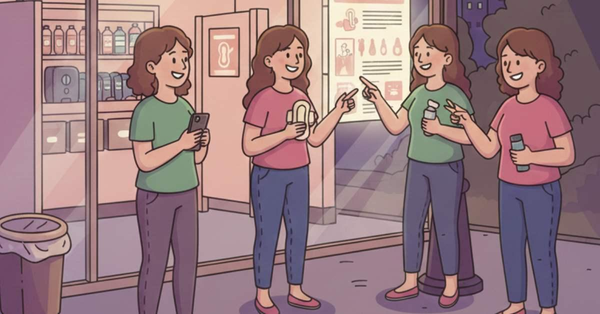
Lack of pad vending machines
Absence of safe disposal facilities
Poorly maintained washrooms
When public infrastructure ignores menstruation, it silently restricts women’s mobility.
The lack of menstrual access disproportionately affects:
School-going girls
Working women
Daily wage workers
Women with heavy or irregular cycles
Women traveling long distances
Consequences include:
Missed school or workdays
Reduced participation in public life
Increased health risks
Emotional stress and embarrassment
Menstrual injustice is not dramatic. It is cumulative and deeply unequal.
The Indian Constitution guarantees:
Equality before law (Article 14)
Non-discrimination on the basis of sex (Article 15)
Right to life with dignity (Article 21)
Right to education (Article 21A)
State duty to improve public health (Article 47)
When public spaces fail to accommodate menstruation, they indirectly violate these principles by making women’s participation conditional.
Justice cannot exist where dignity is compromised.
Menstrual access in public spaces is often treated as:
Emergency aid
CSR activity
NGO-led intervention
Temporary pilot project
This approach is flawed.
Sanitary pads are not donations. They are necessities like soap, water, and toilets. Menstrual justice demands a shift from charity to institutional responsibility.
Bridging the gap between awareness and action requires systemic change.
Action-oriented menstrual justice includes:
Mandatory sanitary pad availability in public washrooms
Pad vending machines in high-footfall areas
Free access in schools and government buildings
Affordable access in transport hubs
Clear signage and maintenance accountability
Safe and environmentally responsible disposal systems
Action makes awareness meaningful.
Without mandates, implementation remains inconsistent. Countries that have progressed in menstrual justice rely on:
Legal frameworks
Budget allocation
Monitoring mechanisms
Clear standards
India’s policies recognise menstrual hygiene, but lack enforceable standards for public spaces. This gap must be addressed to ensure uniform access.
Menstrual justice is not a niche concern. It improves:
Public health outcomes
School attendance and learning
Workplace productivity
Urban inclusivity
Gender-sensitive governance
A society that plans for menstruation plans better for care, equity, and resilience.
Posters, campaigns, and hashtags matter, but they cannot replace pads in washrooms.
True progress is quiet and practical:
A pad when it is urgently needed
A bin where disposal is safe
A washroom that does not induce fear
Justice is felt in moments, not slogans.
Menstrual justice in public places is not about special treatment. It is about equal participation. When public spaces are designed to support menstruation, women move freely, work confidently, study consistently, and travel without fear.
India has spoken loudly about menstruation. Now it must act decisively.
Awareness opened the door. Action must allow women to walk through it with dignity.
Constitution of India – Articles 14, 15, 21, 21A, 47
Ministry of Health & Family Welfare – Menstrual Hygiene Guidelines
UNICEF India – Menstrual Health and Public Infrastructure
National Education Policy (NEP) 2020
World Health Organization – Menstrual Health and Hygiene Framework
Dr. Shreya Karan is a dedicated oral and maxillofacial surgeon who brings over ten years of experience to her practice, combining surgical expertise with genuine care for her patients. She is dedicated to empowering women with accurate, evidence-based health information, helping them make informed decisions about their well-being.
About PeriodSakhi
PeriodSakhi is your trusted companion for understanding your menstrual health. With easy-to-use tools, it helps you track your periods, ovulation, fertility, moods, and symptoms, while providing insights into your overall reproductive and hormonal health. PeriodSakhi also serves as a supportive online community where women can share experiences, find reliable information, and access expert-backed guidance on menstrual health, PCOS, pregnancy, lifestyle, and more.
Disclaimer
The views, thoughts, and opinions expressed in this article/blog are solely those of the author and do not necessarily reflect the views of PeriodSakhi. Any omissions, errors, or inaccuracies are the responsibility of the author. PeriodSakhi assumes no liability or responsibility for any content presented. Always consult a qualified medical professional for specific advice related to menstrual health, fertility, pregnancy, or related conditions.