
“Not every cyst is a cause for fear but some are simply a part of your body’s natural rhythm.”
Ovarian cysts are a common finding in women of reproductive age. Hearing the word “cyst” often creates anxiety, but the truth is that not all cysts are harmful. Many are a normal part of the menstrual cycle and resolve on their own.
This article is meant for general awareness only and should not replace medical advice. Always consult a qualified doctor for proper diagnosis and treatment.
Ovarian cysts are fluid-filled sacs that develop in or on the ovaries. Most women will have at least one cyst at some point in their lives, often without even knowing it.
According to the NHS, ovarian cysts are usually harmless and often disappear without treatment.
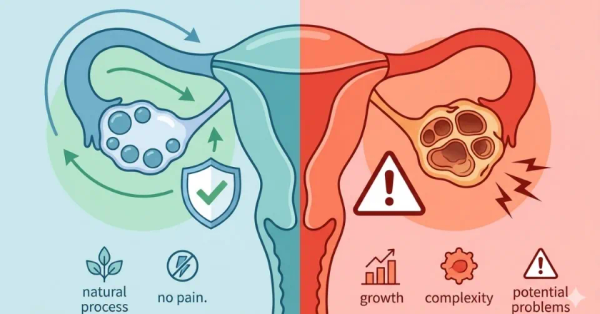
Functional cysts are the most common type and are directly related to your menstrual cycle.
1. Follicular CystThis forms when the follicle does not release an egg and continues to grow.
2. Corpus Luteum CystAfter releasing the egg, the follicle can seal off and fill with fluid.
Usually painless
Often found incidentally on ultrasound
Tend to resolve within a few weeks to months
Rarely require treatment
The Cleveland Clinic notes that functional cysts are a normal part of ovulation and are typically not dangerous.
Unlike functional cysts, pathological cysts are not related to the menstrual cycle. They may arise due to abnormal cell growth.
1. Dermoid Cysts (Teratomas)These may contain hair, skin, or even teeth.
2. CystadenomasFluid-filled cysts that can grow quite large.
3. EndometriomasAssociated with endometriosis, filled with old blood.
They may grow larger over time
Can cause pain or pressure symptoms
May require surgical removal
Rarely, some may be cancerous
As highlighted by the World Health Organization, early evaluation of persistent ovarian masses is important to rule out serious conditions.
While many cysts are silent, consult a doctor if you experience:
Persistent pelvic pain
Bloating or abdominal swelling
Pain during intercourse
Irregular menstrual cycles
Sudden severe pain, which may indicate rupture or torsion
Feature | Functional Cysts | Pathological Cysts |
Cause | Normal menstrual cycle | Abnormal growth |
Risk | Usually harmless | May need treatment |
Duration | Short-term | Can persist or grow |
Treatment | Often none | May need surgery |
No. Most functional cysts resolve on their own and only require monitoring. Treatment is considered if:
The cyst is large
Symptoms are severe
It persists over multiple cycles
There is suspicion of malignancy
Not all ovarian cysts are dangerous. In fact, many are a natural part of your body’s cycle and resolve without intervention. The key lies in understanding the type of cyst and recognizing when medical attention is needed.
If you have been diagnosed with an ovarian cyst or are experiencing symptoms, do not panic. Instead, take a proactive step.
Consult a gynecologist, get the right investigations, and follow up regularly. Early clarity brings peace of mind and better health outcomes.
NHS – Ovarian cyst overview
Cleveland Clinic – Functional vs pathological cysts
World Health Organization – Women’s reproductive health guidance
Dr. Shreya Karan is a dedicated oral and maxillofacial surgeon who brings over ten years of experience to her practice, combining surgical expertise with genuine care for her patients. She is dedicated to empowering women with accurate, evidence-based health information, helping them make informed decisions about their well-being.
About PeriodSakhi
PeriodSakhi is your trusted companion for understanding your menstrual health. With easy-to-use tools, it helps you track your periods, ovulation, fertility, moods, and symptoms, while providing insights into your overall reproductive and hormonal health. PeriodSakhi also serves as a supportive online community where women can share experiences, find reliable information, and access expert-backed guidance on menstrual health, PCOS, pregnancy, lifestyle, and more.
Disclaimer
The views, thoughts, and opinions expressed in this article/blog are solely those of the author and do not necessarily reflect the views of PeriodSakhi. Any omissions, errors, or inaccuracies are the responsibility of the author. PeriodSakhi assumes no liability or responsibility for any content presented. Always consult a qualified medical professional for specific advice related to menstrual health, fertility, pregnancy, or related conditions.